Dispatch Review respectfully acknowledges the Whadjuk people as the traditional owners and custodians of the lands upon which we live and work. We pay deep respect to Elders past and present. Always was, always will be Aboriginal land.
Reviews:
- There is nothing you need to do here, by Riley Landau.
- All alone in the dark: After Elvira Madigan (1967), Salon dans l’obscurité, by Amy Hickman.
- Hatched Dispatched 2026 by Lilian Brown, Lucy Kilroe, Riley Landau, Cassandra Otterman-Emmett, and Charlotte Newman.
- Felix McNamara’s Atrocities by Patrick Zaia.
- Once More with Feeling by Grace Coppola.
- Deanna Hitti's Dangerous Pleasures by Anna Daly.
- Sherrie Levine: Press Release by Sam Beard.
- BCC at Blindside by Diego Ramírez.
- Jack Ball, Mystery Solved by Siân McIntyre.
- 2026 Power 100 by Dispatch Review.
- Patches in a Glowing Landscape: A Reading Gregory Pryor’s Huddle Exhibition by Jonathan W. Marshall.
- Pure Intention: Singapore Biennale 2025–26 by Marco Marcon.
- Gemma Weston, WITNESSING by Sam Beard and Francis Russell.
- Painting Itself: Artist Interviews by Felicity Ostergaard and William Bromage.
- Flooding The Zone by Paul Sutherland.
- Something Old, Something New by Duncan McKay.
- Theo Koning by Marco Marcon.
- Jacob Kotzee: Stimela by Grace Coppola.
- Feel Bad Hit of the Summer Pt. 2 by Francis Russell.
- Isn’t there someone you forgot to ask? by Amy Hickman.
- Isabel Bereczky: Outsole by Chelsea Hopper.
- On Dreaming by Stirling Kain.
- Feel Bad Hit of the Summer Pt. 1 by Francis Russell.
- Lucas “Granpa” Abela at _____g.s by Nalinie See.
- Alana Hunt, A Deceptively Simple Need, PICA by Marco Marcon.
- Wang Qingsong’s Everlasting Inscription by Sam Beard.
- Dispatch Review's 2025 Wrap-up.
- Ripairian: Imprinting the Living Landscape by Annette Peterson.
- Corpse-Watching Comes to Perth by Riley Landau.
- Queering Kin: Amos Gebhardt’s Family Portrait by Riley Landau.
- Forget AI by Francis Russell.
- Acid Utopia: Judgment Day by Aimee Dodds.
- Mollescent Irritant: Liam Gillick at Disneyland Paris by Aimee Dodds.
- Kieron Broadhurst and Ash Tower: Border Chronicle by Soph Grey.
- Nan Goldin, Voyeurism, and the NGA by Jess van Heerden.
- Bombard the Headquarters: An Interview with Linda Jaivin by Sam Beard.
- Hatched Dispatched 2025, by Maraya Takoniatis, Riley Landau, Nalinie See, Kye Fisher, and Jess van Heerden.
- Sneak Out by Tara Heffernan.
- By Chance, Li Gang by Sam Beard.
- Nazila Jahangir, Immigration by Sam Beard.
- Regenerative Strategies: A Celestial Reflection by Jess van Heerden.
- Cast in (Mostly) Bronze at AGWA by Riley Landau.
- Missed Shows and Mini Reviews by Darren Jorgensen, Riley Landau, Amelia Birch, and Sam Beard.
- 2025 Power 100, by Dispatch Review.
- Dan Bourke, Keywords, AVA by Francis Russell.
- Revivification at AGWA by Angus Bowskill.
- The Australian Dream and other Fictions by Jess van Heerden.
- The Vessel Report by Sam Beard.
- Jacob Kotzee’s flowerfield by Scott Price.
- Jeff Gibson: False Gestalt by Francis Russell.
- Skyward, or Boonji Spaceman and the Giant Kebab by Nick FitzPatrick.
- Sam Bloor and Jesse Marlow: Street Posters 2020–2025 by Sam Beard.
- Mervyn Street: Stolen Wages by Darren Jorgensen.
- 100 Sculpture Ideas for Sculptures by the Sea by Rainy Colbert.
- Kate Mitchell’s Idea Induction by Amelia Birch.
- Mai Nguyễn-Long’s Doba Nation by Sam Beard.
- A conversation with Jo Darbyshire, by Stirling Kain.
- Dispatch Review’s 2024 Wrap-up.
- The people yearn... by Max Vickery and Erin Russell.
- An invitation to dance by Sam Beard.
- We Talk, We Discuss: An Interview with Taring Padi by Max Vickery.
- AGWA x PrideFEST by Felicity Bean.
- Tim Meakins, Body Mould by Sam Beard.
- Nick FitzPatrick, Hero Image by Francis Russell.
- Jacob Kotzee, Arrangements by Dan Glover.
- Hollow Icons: Desmond Mah at Mossenson by Darren Jorgensen.
- Pilgrimage: An interview with Vedika Rampal.
- The UnAustralian: Doubling Double Nation – An interview with Rex Butler.
- Negative Criticism: A Year of Dispatch Review by Tara Heffernan.
- Custodians as Reverse Monument by Darren Jorgensen.
- End of History – LWAG by Francis Russell.
- Hatched Dispatched 2024 by Dan Glover, Jess van Heerden, Nalinie See & Sam Beard.
- David Bromfield: A critic at large and ‘Where did the artists go?’
- Me, Also Me by Sam Beard.
- Paper Trails Between Lion and Swan by Sam Beard.
- Ceramically Speaking by Ben Yaxley.
- The Strelley Mob by Sam Harper.
- Rone: The Mighty Success by Leslie Thompson.
- Paper Trails: An interview with Yeo Chee Kiong by Sam Beard.
- 2024 Power 100 by Dispatch Review.
- Foresight & Fiction by Ben Yaxley.
- Twin Peaks Was 30 by Matthew Taggart.
- Breaking News: It’s Rone! by Sam Beard.
- Look, looking at Anna Park by Amelia Birch.
- The Fan by Francis Russell.
- Follower, Leader by Maraya Takoniatis.
- Wanneroo Warholamania by Sam Beard.
- Death Metal Summer by Sam Beard.
- Players, Places: Reprised, Renewed, Reviewed by Aimee Dodds.
- Scholtz: Two Worlds Apart by Corderoy, Fisher, Flaherty, Wilson, Fletcher, Jorgensen, & Glover.
- Partial Sightings by Sam Beard.
- True! Crime. by Aimee Dodds.
- The Human Condition by Rex Butler.
- Rebecca Baumann’s Light Event by Sam Beard.
- Rejoinder: Archival / Activism by Max Vickery.
- Access and Denial in The Purple Shall Govern by Jess van Heerden.
- 4Spells by Sam Beard.
- Abstract art, DMT capitalism and the ugliness of David Attwood’s paintings
by Darren Jorgensen. - Unearthing new epistemologies of extraction by Samuel Beilby.
- Seek Wisdom by Max Vickery.
- Something for Everyone by Sam Beard.
- Violent Sludge by Aimee Dodds.
- State of Abstraction by Francis Russell.
- Double Histories: Special Issue, with texts by Ian McLean, Terry Smith, and Darren Jorgensen & Sam Beard.
- Six Missing Shows by Sam Beard.
- What We Memorialise by Max Vickery.
- At the End of the Land by Amelia Birch.
- The beautiful is useful by Sam Beard.
- ām / ammā / mā maram by Zali Morgan.
- Making Ground, Breaking Ground by Maraya Takoniatis.
- Art as Asset by Sam Beard.
- Cactus Malpractice by Aimee Dodds.
- Sweet sweet pea by Sam Beard.
- COBRA by Francis Russell.
- PICA Barn by Sam Beard.
- Gallery Hotel Metro by Aimee Dodds.
- A Stroll Through the Sacred, Profane, and Bizarre by Samuel Beilby.
- Filling in the Gaps at Spacingout by Maraya Takoniatis.
- Disneyland Cosmoplitanism by Sam Beard.
- Discovering Revenue by Amelia Birch.
- Uncomfortable Borrowing by Jess van Heerden.
- It’s Not That Strange by Stirling Kain.
- Hatched Dispatched 2023 by Sam Beard & Aimee Dodds.
- Fuck the Class System by Jess van Heerden, Jacinta Posik, Darren Jorgensen, et al.
- Wild About Nothing by Sam Beard.
- Paranoiac, Peripatetic: Pet Projects by Aimee Dodds.
- An Odd Moment for Women’s Art by Maraya Takoniatis.
- Transmutations by Sam Beard.
- The Post-Vandal by Sam Beard.
- Art Thugs and Humbugs by Max Vickery.
- Disneyland, Paris, Ardross and the artworld by Darren Jorgensen.
- Bizarrely, A Biennale by Aimee Dodds.
- Venus in Tullamarine by Sam Beard.
- Weird Rituals by Sam Beard.
- Random Cube by Francis Russell.
- Yeah, Nah, Rockpool by Aimee Dodds.
- Towards a Blind Horizon by Kieron Broadhurst.
- Being Realistic by Sam Beard.
It’s the modern-day equivalent of seeing hair floating on water: a shoe washed up on a shoreline. While both function as signs of death, the latter reads differently. It implies a narrative. An absence. A body no longer attached. And it is this fragment that becomes the catalyst for Isabel Bereczky’s solo exhibition Outsole at Light Works.
Walking into the space as the final leg of a three-day art history conference at the other end of town, the shift in register is immediate. The gallery space is part of a somewhat hidden multipurpose venue, accessed through a nondescript door on Murray Street beneath a former Hubbard Dianetics centre, which leads to a narrow concrete passage lit by a long strip of fluorescents. Exposed pipes and scuffed walls. The descent feels less like entering a gallery than stepping into the building’s underside, its basement corridors and storage spaces. It is a fitting prelude to a show concerned with what resurfaces.
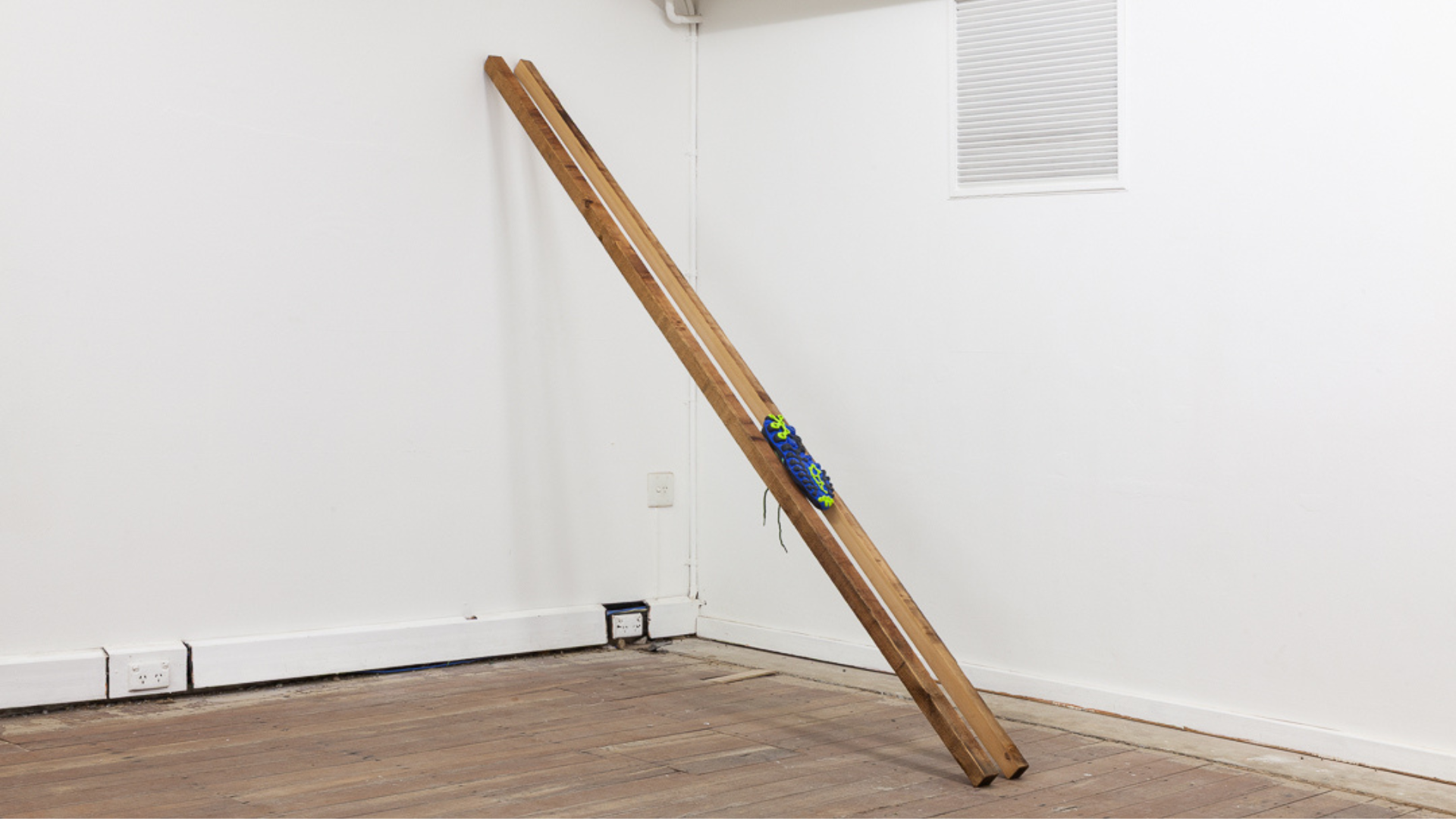
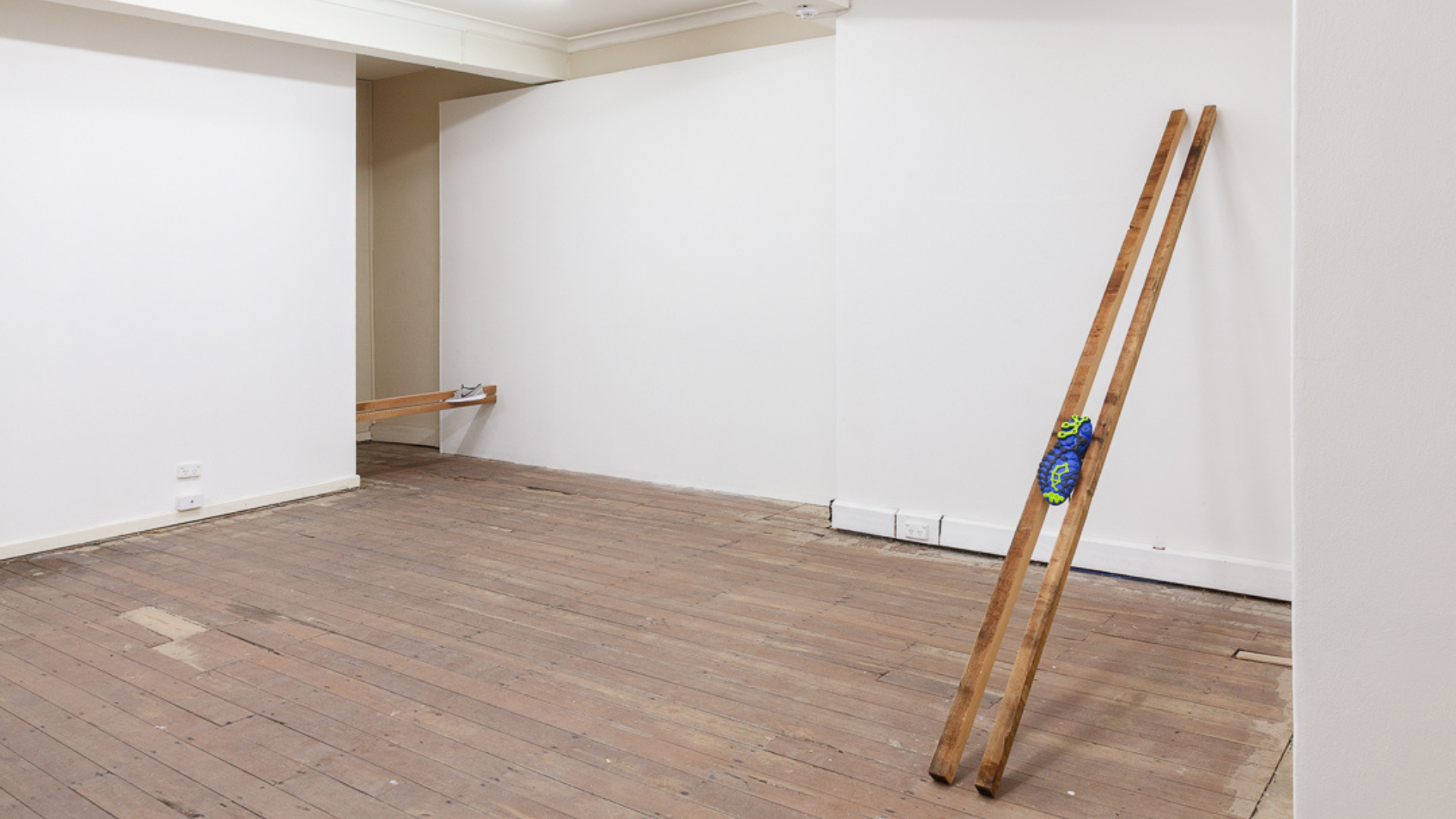
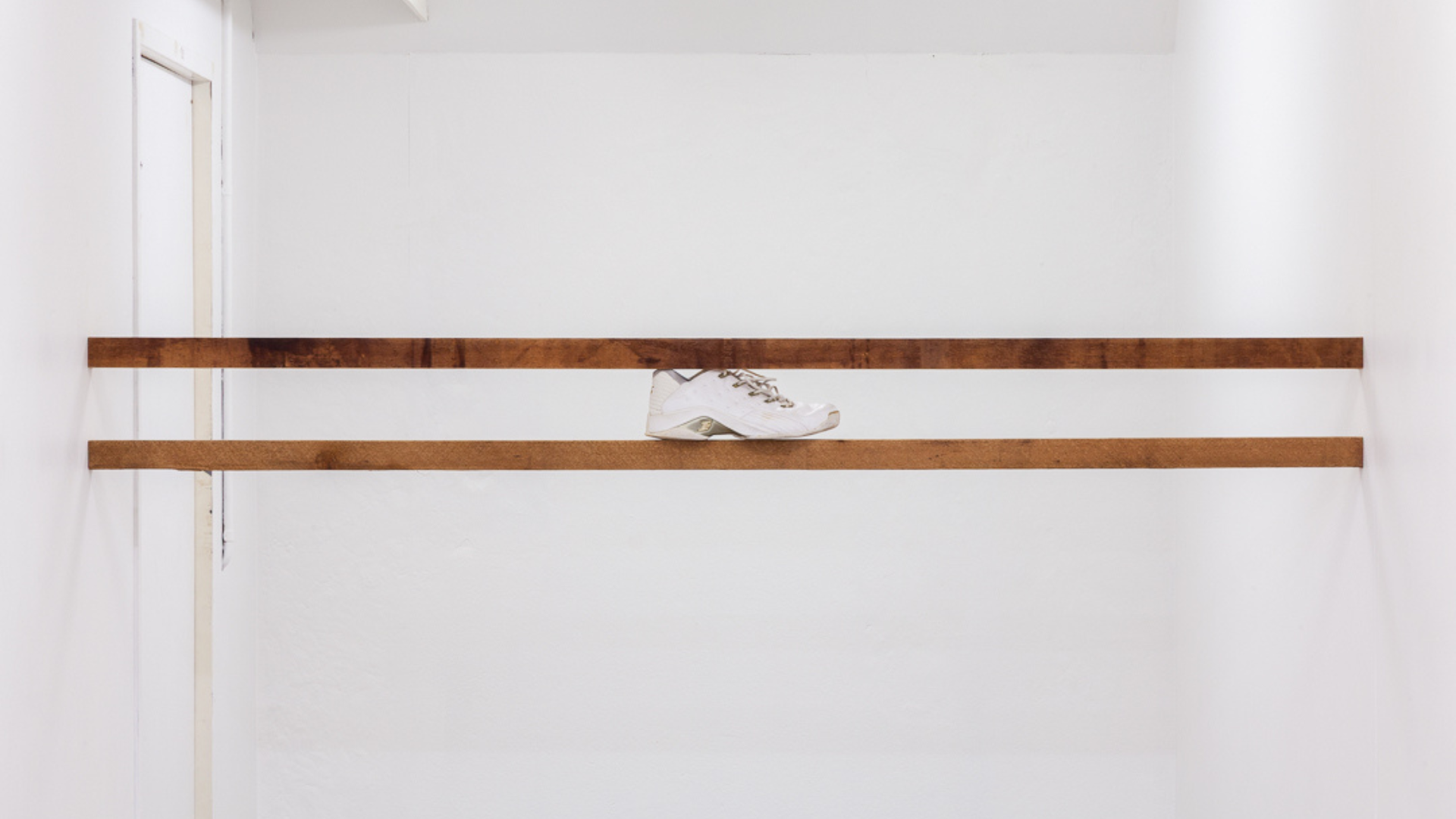
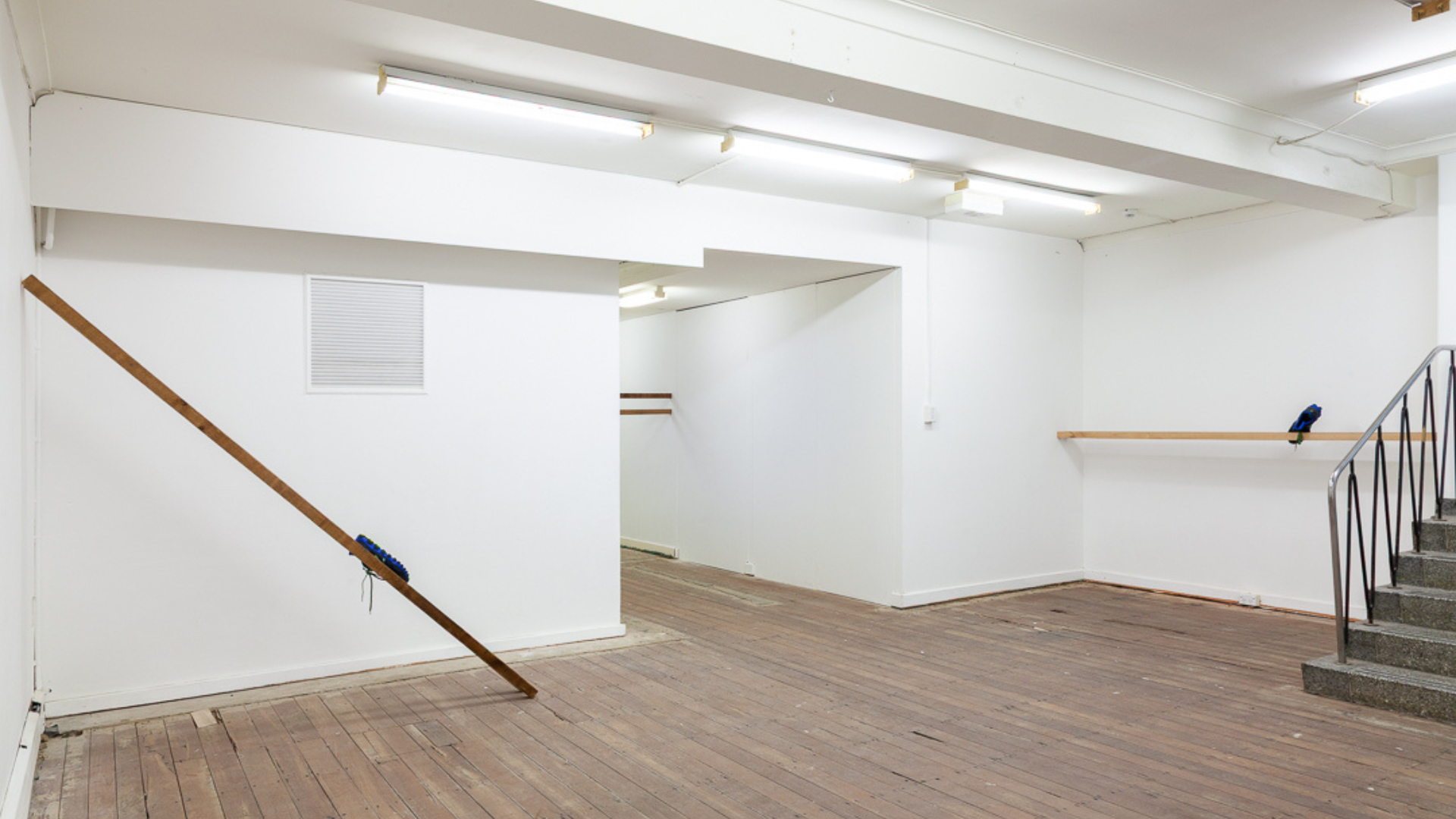
The exhibition is pared back and entirely specific. The timber lengths, either tilted or tightly propped between the gallery walls, read at first as a formal exercise in restraint. It recalls the Minimalism of John McCracken’s leaning planks, Richard Serra’s plates, and even Bruce Nauman’s claustrophobic 1969 Performance Corridor. The planks insist on a single object, isolating it, pinning it in place, holding the viewer’s attention on what is caught between them: the sneaker. Across the gallery’s brightly lit space, four sneakers are trapped between two planks of western red cedar, snagged or wedged along their clean horizontal beams or angled into steep diagonals.
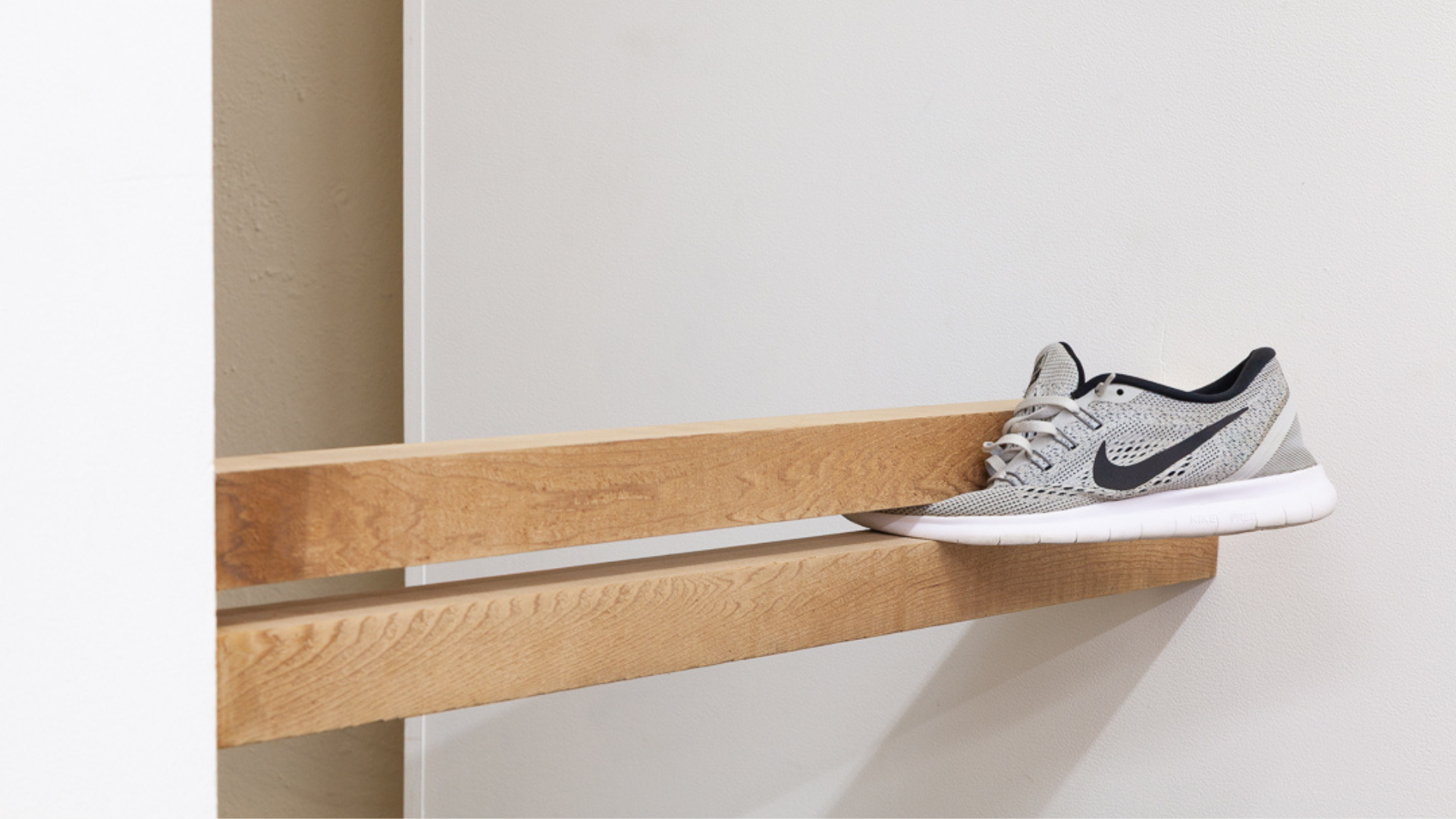
Up close, the sneakers feel oddly particular. The Reebok Answer 13 sits suspended at eye level, a men’s size 13, chunky and padded, its white leather creased and slightly soiled, the shoelaces hanging in loose, uneven loops. The Nike Flyknit Free RN, by contrast, looks almost weightless, a grey woven skin stretched over a clean white sole, the black swoosh crisp against its mesh, the tip jammed between the beams closest to the ground. It’s the kind of running shoe my dad’s friends wear daily. The New Balance 3090 V2 is the most visually charged. All electric blue and black honeycomb panelling, punctuated with neon green, revealed as the left shoe, size 11.5, it hangs upside down, with its laces knotted and left to trail below the timber beams, dangling in loose loops like seaweed. Its right counterpart is wedged opposite it, tilting upward at a sharp diagonal, its tongue slack, the sole turned outward and fully visible. Like any shoe, it is engineered for movement, built around the promise of propulsion. Here, Bereczky stalls that promise. The shoes remain suspended, snagged, and held along the cedar’s clean lines.
![]()
It is only upon reading the exhibition text that the sneakers lose their neutrality. They are not simply found objects but stand-ins for shoes recovered from the Salish Sea coastline in British Columbia between 2007 and 2018. The text lists their dates of discovery: 26 August 2007, 7 February 2016, 12 February 2016, 20 September 2018.
The shoe models, down to their sizes, sit within a longer chronology of more than twenty sneakers discovered since 2007, each containing disarticulated human feet. Investigation remains ongoing. I continue reading: “Approximately half of the sneakers (feet) have been forensically linked to reported missing persons. Of those on display, DNA matches to missing persons remain private or inconsistent across reports.” This phrasing is blunt, almost procedural. So, what, then, are we to make of their reappearance here, against the backdrop of another Commonwealth coastline?
What travels here is not the ocean but narrative. Like the teenage murder at the centre of the final chapter in Chris Kraus’s recent novel, The Four Spent the Day Together, the event itself remains elsewhere, mediated through documentation, testimony, and reconstruction. In Outsole, the violence is similarly displaced. The body does not arrive, only the object. Yet where Kraus works through fictional retelling, reworking the true-crime genre itself, Bereczky holds close to evidence. Dates, models, sizes. The effect is not catharsis but a confronting proximity where the work insists that what has been recovered cannot be smoothed into story. Instead, Bereczky refuses to narrativise the sneakers into anything satisfying or resolute for the viewer.
Working with such forensic residue, I am reminded of Francis Carmody’s project Lost & Found Recovery (2022), in which the artist set out to return fifteen lost hats to their owners. Carmody mobilised an absurd but telling range of expertise, consulting a police detective, a psychic, a DNA scientist, and an ITVSN salesperson, as though each hat might be decoded like a crime-scene artefact.
Bereczky’s sneakers also elicit the work of Morag Keil, an artist who collects abandoned or misplaced footwear for her large wall sculpture Clock. With each iteration, Keil gathers a different set of shoes from its immediate surroundings, and so the work shifts with location, its composition determined by what has been left behind. Sporadically arranged in a circle, the shoes are repurposed as numerals in a surreal dial that operates as a functioning clock. Their worn soles and wrinkled leather operate almost indexically, recording the many steps taken before separation from their wearer, of unknown lives.
In Outsole, however, this logic is fixed rather than contingent. Bereczky’s sneakers are not gathered locally but sourced by scouring eBay, their selection preconditioned by forensic record. Each model corresponds to a documented discovery, already tethered to a missing person. Specific makes. Specific dates. The circle of time gives way to the coastline. The shoes do not wash up here, but they arrive all the same.
Isabel Bereczky, Outsole, Light Works, 5 – 7 December 2025.
Images: Isabel Bereczky, Outsole (Installation view), at Light Works. Photography by Scott Burton. Courtesy of the artist.
Walking into the space as the final leg of a three-day art history conference at the other end of town, the shift in register is immediate. The gallery space is part of a somewhat hidden multipurpose venue, accessed through a nondescript door on Murray Street beneath a former Hubbard Dianetics centre, which leads to a narrow concrete passage lit by a long strip of fluorescents. Exposed pipes and scuffed walls. The descent feels less like entering a gallery than stepping into the building’s underside, its basement corridors and storage spaces. It is a fitting prelude to a show concerned with what resurfaces.
The exhibition is pared back and entirely specific. The timber lengths, either tilted or tightly propped between the gallery walls, read at first as a formal exercise in restraint. It recalls the Minimalism of John McCracken’s leaning planks, Richard Serra’s plates, and even Bruce Nauman’s claustrophobic 1969 Performance Corridor. The planks insist on a single object, isolating it, pinning it in place, holding the viewer’s attention on what is caught between them: the sneaker. Across the gallery’s brightly lit space, four sneakers are trapped between two planks of western red cedar, snagged or wedged along their clean horizontal beams or angled into steep diagonals.
Up close, the sneakers feel oddly particular. The Reebok Answer 13 sits suspended at eye level, a men’s size 13, chunky and padded, its white leather creased and slightly soiled, the shoelaces hanging in loose, uneven loops. The Nike Flyknit Free RN, by contrast, looks almost weightless, a grey woven skin stretched over a clean white sole, the black swoosh crisp against its mesh, the tip jammed between the beams closest to the ground. It’s the kind of running shoe my dad’s friends wear daily. The New Balance 3090 V2 is the most visually charged. All electric blue and black honeycomb panelling, punctuated with neon green, revealed as the left shoe, size 11.5, it hangs upside down, with its laces knotted and left to trail below the timber beams, dangling in loose loops like seaweed. Its right counterpart is wedged opposite it, tilting upward at a sharp diagonal, its tongue slack, the sole turned outward and fully visible. Like any shoe, it is engineered for movement, built around the promise of propulsion. Here, Bereczky stalls that promise. The shoes remain suspended, snagged, and held along the cedar’s clean lines.
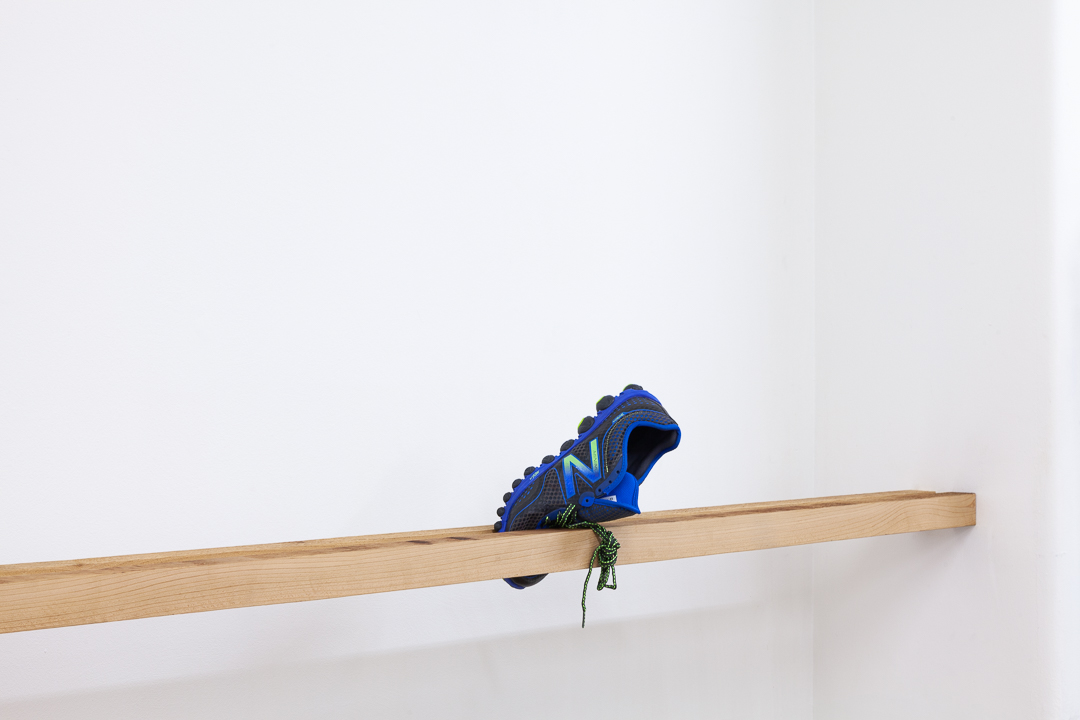
Image: Isabel Bereczky, New Balance 3090 V2 Running Shoes Blue and Black US 11.5 D Medium (right), 2025. New Balance 3090 V2 sneaker, western red cedar, dimensions variable. Photo: Scott Burton. Courtesy the artist.
It is only upon reading the exhibition text that the sneakers lose their neutrality. They are not simply found objects but stand-ins for shoes recovered from the Salish Sea coastline in British Columbia between 2007 and 2018. The text lists their dates of discovery: 26 August 2007, 7 February 2016, 12 February 2016, 20 September 2018.
The shoe models, down to their sizes, sit within a longer chronology of more than twenty sneakers discovered since 2007, each containing disarticulated human feet. Investigation remains ongoing. I continue reading: “Approximately half of the sneakers (feet) have been forensically linked to reported missing persons. Of those on display, DNA matches to missing persons remain private or inconsistent across reports.” This phrasing is blunt, almost procedural. So, what, then, are we to make of their reappearance here, against the backdrop of another Commonwealth coastline?
What travels here is not the ocean but narrative. Like the teenage murder at the centre of the final chapter in Chris Kraus’s recent novel, The Four Spent the Day Together, the event itself remains elsewhere, mediated through documentation, testimony, and reconstruction. In Outsole, the violence is similarly displaced. The body does not arrive, only the object. Yet where Kraus works through fictional retelling, reworking the true-crime genre itself, Bereczky holds close to evidence. Dates, models, sizes. The effect is not catharsis but a confronting proximity where the work insists that what has been recovered cannot be smoothed into story. Instead, Bereczky refuses to narrativise the sneakers into anything satisfying or resolute for the viewer.
Working with such forensic residue, I am reminded of Francis Carmody’s project Lost & Found Recovery (2022), in which the artist set out to return fifteen lost hats to their owners. Carmody mobilised an absurd but telling range of expertise, consulting a police detective, a psychic, a DNA scientist, and an ITVSN salesperson, as though each hat might be decoded like a crime-scene artefact.
Bereczky’s sneakers also elicit the work of Morag Keil, an artist who collects abandoned or misplaced footwear for her large wall sculpture Clock. With each iteration, Keil gathers a different set of shoes from its immediate surroundings, and so the work shifts with location, its composition determined by what has been left behind. Sporadically arranged in a circle, the shoes are repurposed as numerals in a surreal dial that operates as a functioning clock. Their worn soles and wrinkled leather operate almost indexically, recording the many steps taken before separation from their wearer, of unknown lives.
In Outsole, however, this logic is fixed rather than contingent. Bereczky’s sneakers are not gathered locally but sourced by scouring eBay, their selection preconditioned by forensic record. Each model corresponds to a documented discovery, already tethered to a missing person. Specific makes. Specific dates. The circle of time gives way to the coastline. The shoes do not wash up here, but they arrive all the same.
Isabel Bereczky, Outsole, Light Works, 5 – 7 December 2025.
Images: Isabel Bereczky, Outsole (Installation view), at Light Works. Photography by Scott Burton. Courtesy of the artist.