Dispatch Review respectfully acknowledges the Whadjuk people as the traditional owners and custodians of the lands upon which we live and work. We pay deep respect to Elders past and present. Always was, always will be Aboriginal land.
Reviews:
- Felix McNamara’s Atrocities by Patrick Zaia.
- Once More with Feeling by Grace Coppola.
- Deanna Hitti's Dangerous Pleasures by Anna Daly.
- Sherrie Levine: Press Release by Sam Beard.
- BCC at Blindside by Diego Ramírez.
- Jack Ball, Mystery Solved by Siân McIntyre.
- 2026 Power 100 by Dispatch Review.
- Patches in a Glowing Landscape: A Reading Gregory Pryor’s Huddle Exhibition by Jonathan W. Marshall.
- Pure Intention: Singapore Biennale 2025–26 by Marco Marcon.
- Gemma Weston, WITNESSING by Sam Beard and Francis Russell.
- Painting Itself: Artist Interviews by Felicity Ostergaard and William Bromage.
- Flooding The Zone by Paul Sutherland.
- Something Old, Something New by Duncan McKay.
- Theo Koning by Marco Marcon.
- Jacob Kotzee: Stimela by Grace Coppola.
- Feel Bad Hit of the Summer Pt. 2 by Francis Russell.
- Isn’t there someone you forgot to ask? by Amy Hickman.
- Isabel Bereczky: Outsole by Chelsea Hopper.
- On Dreaming by Stirling Kain.
- Feel Bad Hit of the Summer Pt. 1 by Francis Russell.
- Lucas “Granpa” Abela at _____g.s by Nalinie See.
- Alana Hunt, A Deceptively Simple Need, PICA by Marco Marcon.
- Wang Qingsong’s Everlasting Inscription by Sam Beard.
- Dispatch Review's 2025 Wrap-up.
- Ripairian: Imprinting the Living Landscape by Annette Peterson.
- Corpse-Watching Comes to Perth by Riley Landau.
- Queering Kin: Amos Gebhardt’s Family Portrait by Riley Landau.
- Forget AI by Francis Russell.
- Acid Utopia: Judgment Day by Aimee Dodds.
- Mollescent Irritant: Liam Gillick at Disneyland Paris by Aimee Dodds.
- Kieron Broadhurst and Ash Tower: Border Chronicle by Soph Grey.
- Nan Goldin, Voyeurism, and the NGA by Jess van Heerden.
- Bombard the Headquarters: An Interview with Linda Jaivin by Sam Beard.
- Hatched Dispatched 2025, by Maraya Takoniatis, Riley Landau, Nalinie See, Kye Fisher, and Jess van Heerden.
- Sneak Out by Tara Heffernan.
- By Chance, Li Gang by Sam Beard.
- Nazila Jahangir, Immigration by Sam Beard.
- Regenerative Strategies: A Celestial Reflection by Jess van Heerden.
- Cast in (Mostly) Bronze at AGWA by Riley Landau.
- Missed Shows and Mini Reviews by Darren Jorgensen, Riley Landau, Amelia Birch, and Sam Beard.
- 2025 Power 100, by Dispatch Review.
- Dan Bourke, Keywords, AVA by Francis Russell.
- Revivification at AGWA by Angus Bowskill.
- The Australian Dream and other Fictions by Jess van Heerden.
- The Vessel Report by Sam Beard.
- Jacob Kotzee’s flowerfield by Scott Price.
- Jeff Gibson: False Gestalt by Francis Russell.
- Skyward, or Boonji Spaceman and the Giant Kebab by Nick FitzPatrick.
- Sam Bloor and Jesse Marlow: Street Posters 2020–2025 by Sam Beard.
- Mervyn Street: Stolen Wages by Darren Jorgensen.
- 100 Sculpture Ideas for Sculptures by the Sea by Rainy Colbert.
- Kate Mitchell’s Idea Induction by Amelia Birch.
- Mai Nguyễn-Long’s Doba Nation by Sam Beard.
- A conversation with Jo Darbyshire, by Stirling Kain.
- Dispatch Review’s 2024 Wrap-up.
- The people yearn... by Max Vickery and Erin Russell.
- An invitation to dance by Sam Beard.
- We Talk, We Discuss: An Interview with Taring Padi by Max Vickery.
- AGWA x PrideFEST by Felicity Bean.
- Tim Meakins, Body Mould by Sam Beard.
- Nick FitzPatrick, Hero Image by Francis Russell.
- Jacob Kotzee, Arrangements by Dan Glover.
- Hollow Icons: Desmond Mah at Mossenson by Darren Jorgensen.
- Pilgrimage: An interview with Vedika Rampal.
- The UnAustralian: Doubling Double Nation – An interview with Rex Butler.
- Negative Criticism: A Year of Dispatch Review by Tara Heffernan.
- Custodians as Reverse Monument by Darren Jorgensen.
- End of History – LWAG by Francis Russell.
- Hatched Dispatched 2024 by Dan Glover, Jess van Heerden, Nalinie See & Sam Beard.
- David Bromfield: A critic at large and ‘Where did the artists go?’
- Me, Also Me by Sam Beard.
- Paper Trails Between Lion and Swan by Sam Beard.
- Ceramically Speaking by Ben Yaxley.
- The Strelley Mob by Sam Harper.
- Rone: The Mighty Success by Leslie Thompson.
- Paper Trails: An interview with Yeo Chee Kiong by Sam Beard.
- 2024 Power 100 by Dispatch Review.
- Foresight & Fiction by Ben Yaxley.
- Twin Peaks Was 30 by Matthew Taggart.
- Breaking News: It’s Rone! by Sam Beard.
- Look, looking at Anna Park by Amelia Birch.
- The Fan by Francis Russell.
- Follower, Leader by Maraya Takoniatis.
- Wanneroo Warholamania by Sam Beard.
- Death Metal Summer by Sam Beard.
- Players, Places: Reprised, Renewed, Reviewed by Aimee Dodds.
- Scholtz: Two Worlds Apart by Corderoy, Fisher, Flaherty, Wilson, Fletcher, Jorgensen, & Glover.
- Partial Sightings by Sam Beard.
- True! Crime. by Aimee Dodds.
- The Human Condition by Rex Butler.
- Rebecca Baumann’s Light Event by Sam Beard.
- Rejoinder: Archival / Activism by Max Vickery.
- Access and Denial in The Purple Shall Govern by Jess van Heerden.
- 4Spells by Sam Beard.
- Abstract art, DMT capitalism and the ugliness of David Attwood’s paintings
by Darren Jorgensen. - Unearthing new epistemologies of extraction by Samuel Beilby.
- Seek Wisdom by Max Vickery.
- Something for Everyone by Sam Beard.
- Violent Sludge by Aimee Dodds.
- State of Abstraction by Francis Russell.
- Double Histories: Special Issue, with texts by Ian McLean, Terry Smith, and Darren Jorgensen & Sam Beard.
- Six Missing Shows by Sam Beard.
- What We Memorialise by Max Vickery.
- At the End of the Land by Amelia Birch.
- The beautiful is useful by Sam Beard.
- ām / ammā / mā maram by Zali Morgan.
- Making Ground, Breaking Ground by Maraya Takoniatis.
- Art as Asset by Sam Beard.
- Cactus Malpractice by Aimee Dodds.
- Sweet sweet pea by Sam Beard.
- COBRA by Francis Russell.
- PICA Barn by Sam Beard.
- Gallery Hotel Metro by Aimee Dodds.
- A Stroll Through the Sacred, Profane, and Bizarre by Samuel Beilby.
- Filling in the Gaps at Spacingout by Maraya Takoniatis.
- Disneyland Cosmoplitanism by Sam Beard.
- Discovering Revenue by Amelia Birch.
- Uncomfortable Borrowing by Jess van Heerden.
- It’s Not That Strange by Stirling Kain.
- Hatched Dispatched 2023 by Sam Beard & Aimee Dodds.
- Fuck the Class System by Jess van Heerden, Jacinta Posik, Darren Jorgensen, et al.
- Wild About Nothing by Sam Beard.
- Paranoiac, Peripatetic: Pet Projects by Aimee Dodds.
- An Odd Moment for Women’s Art by Maraya Takoniatis.
- Transmutations by Sam Beard.
- The Post-Vandal by Sam Beard.
- Art Thugs and Humbugs by Max Vickery.
- Disneyland, Paris, Ardross and the artworld by Darren Jorgensen.
- Bizarrely, A Biennale by Aimee Dodds.
- Venus in Tullamarine by Sam Beard.
- Weird Rituals by Sam Beard.
- Random Cube by Francis Russell.
- Yeah, Nah, Rockpool by Aimee Dodds.
- Towards a Blind Horizon by Kieron Broadhurst.
- Being Realistic by Sam Beard.
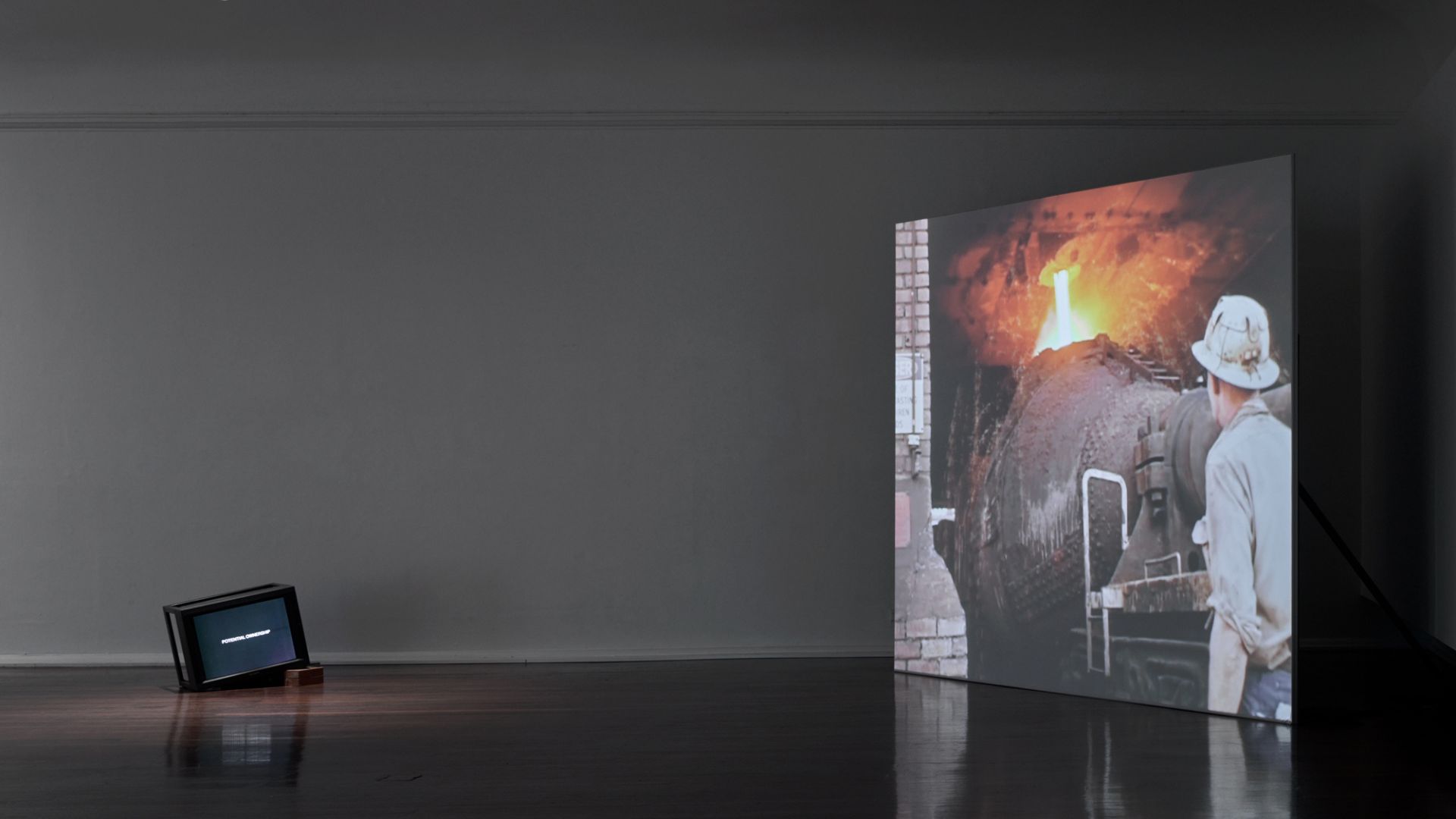
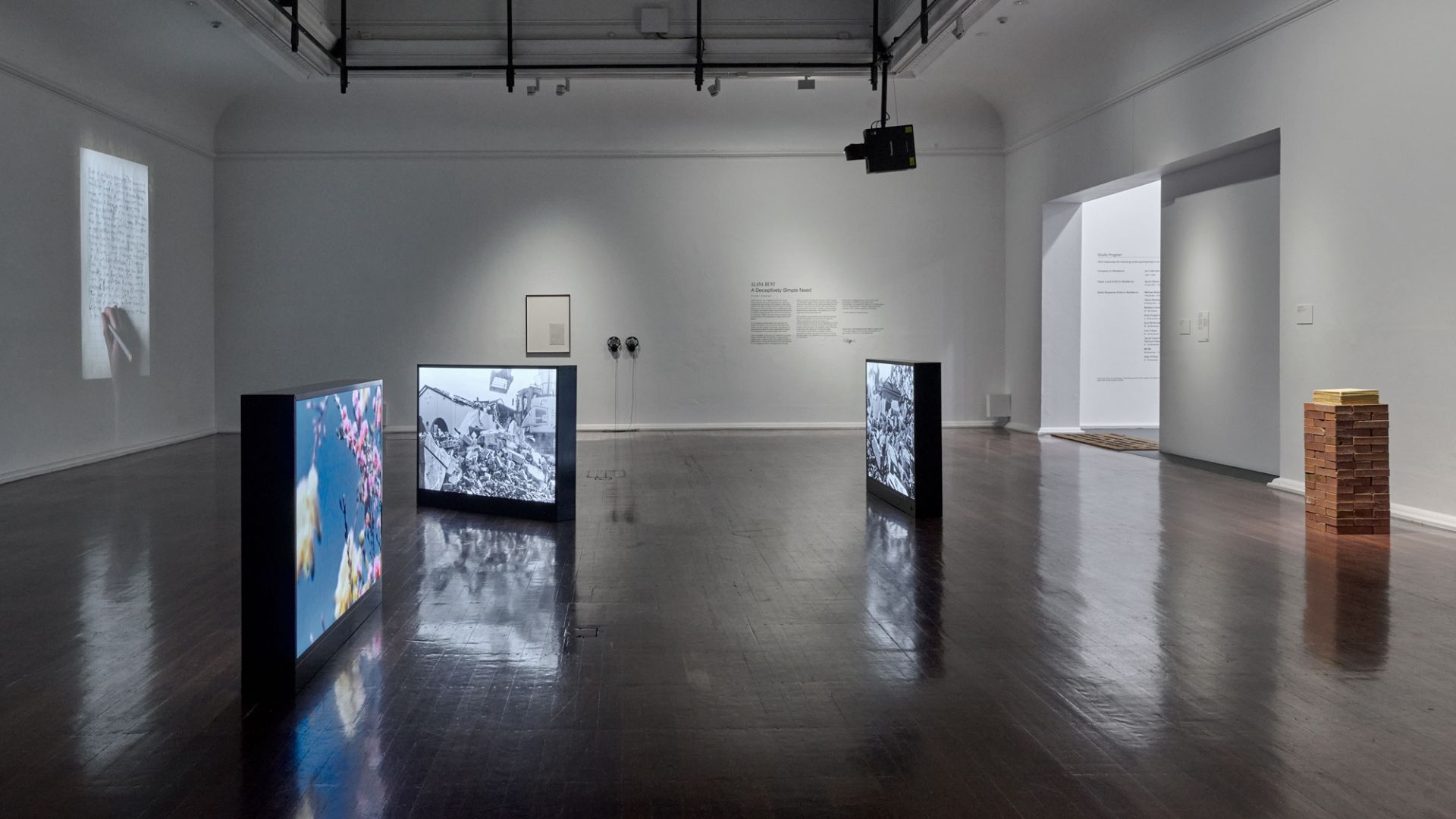
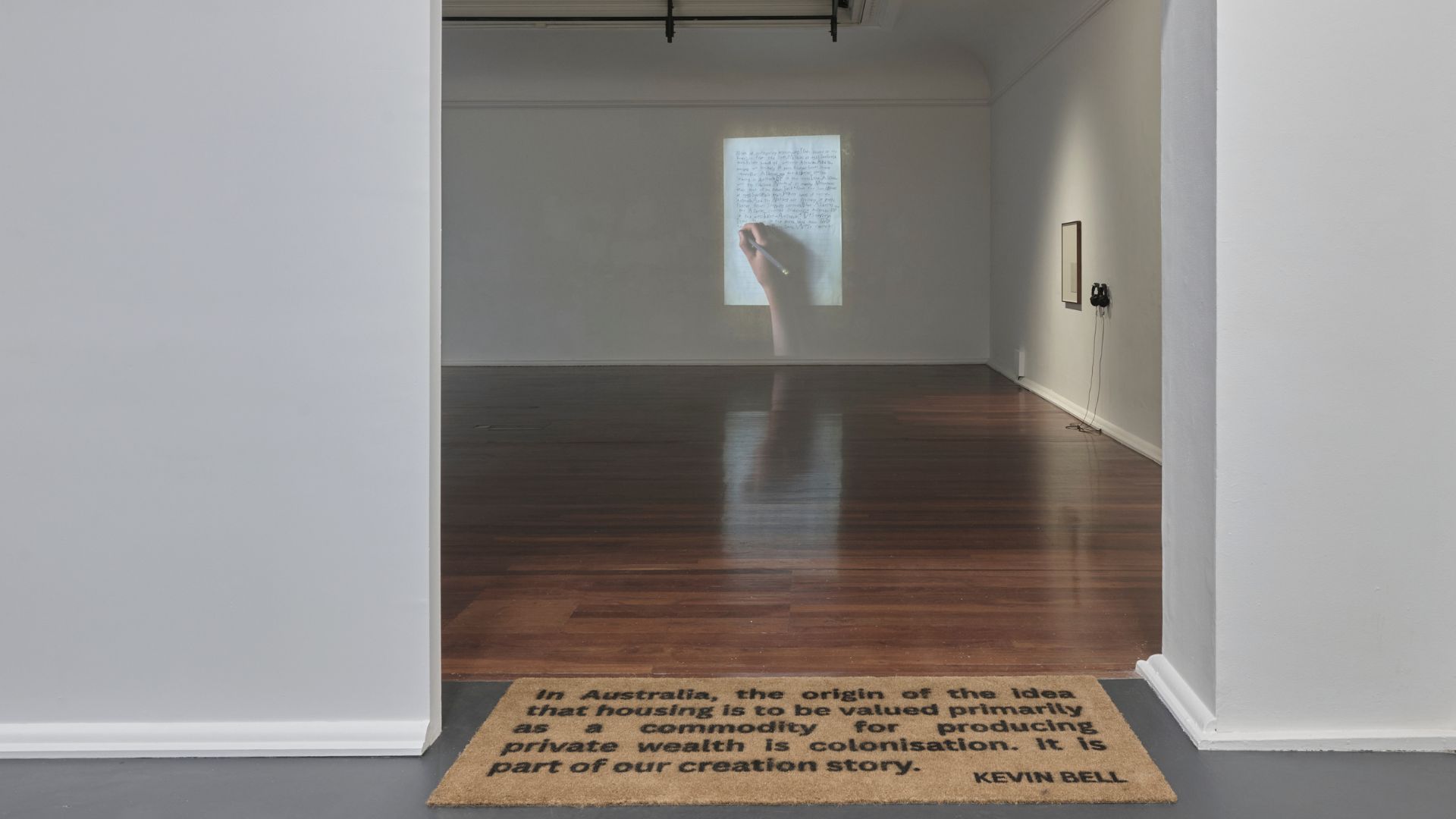
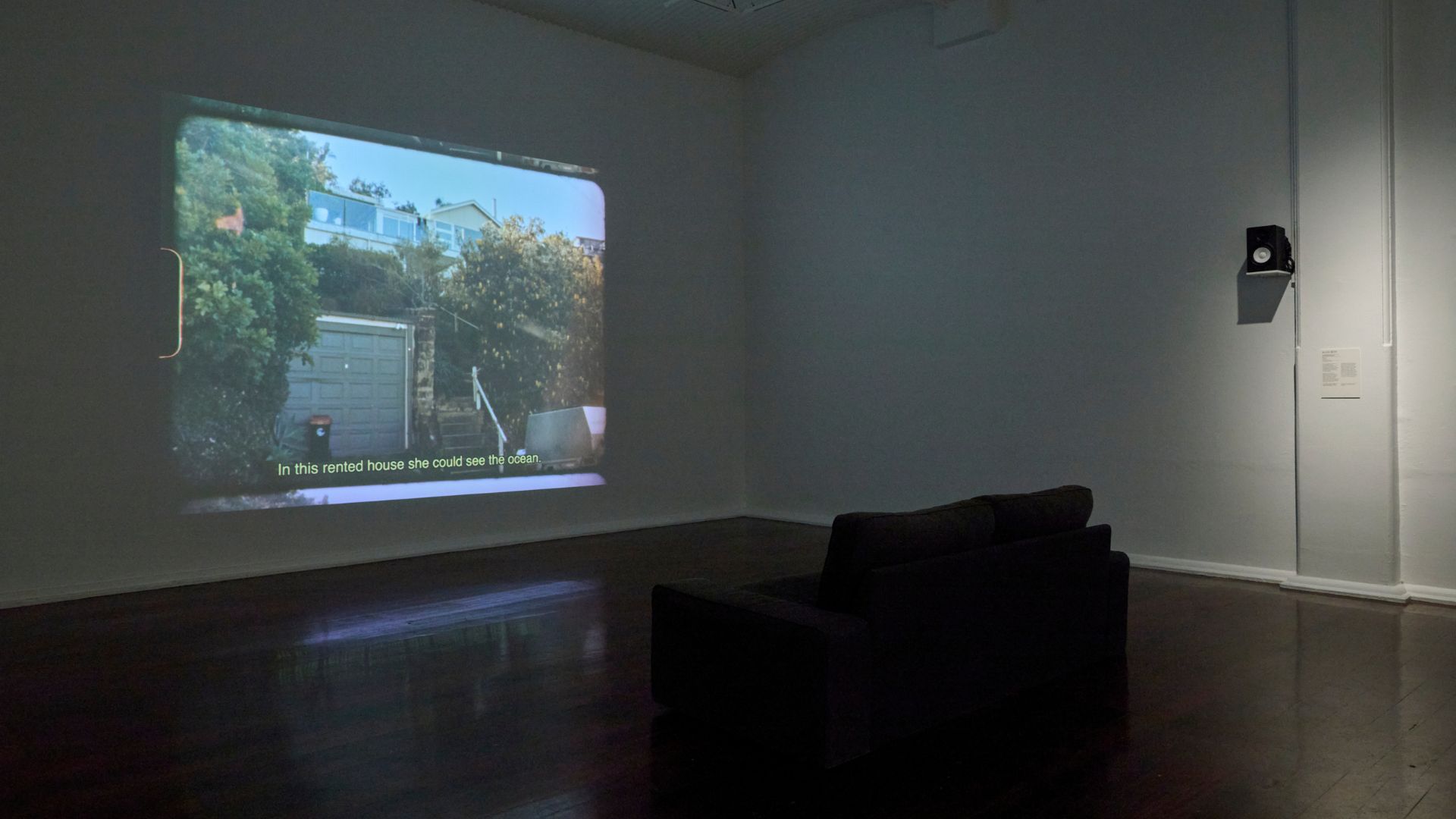
After visiting Alana Hunt’s solo show at PICA, I wondered if we, the contemporary art public, are becoming accustomed to asking too little of artists. Hunt’s exhibition occupied the entire ground floor of the gallery, and yet, when all is said and done, the only substantial work to be found was the video piece in the last room. This was a seemingly autobiographical narrative about growing up in various rented suburban houses as the child of a single mother; it was both lyrical and captivating.
The rest of the exhibition could be described as “quasi-didactic minimalism,” interspersed with—and redeemed by—biographical touches. All the works revolve around the relationship between home ownership as capital accumulation and the colonial expropriation of Aboriginal land. I am sympathetic to the topic. Like Alana Hunt, I never bothered to buy a home, and now I find myself infinitely poorer than the friends, family, and colleagues who understood the importance of a freehold title. On the plus side, I can boast that I don’t own stolen land; I just lease it! Contrary to leftist homeowners who, on certain public occasions, feel they must show contrition for owning land they admit is stolen but have no intention of returning, I can at least say: “Take it up with my landlord, that bastard!” Of course, it’s a flimsy defence, but it’s all Alana Hunt, and I have.
The exhibition implicitly divides the Australian population into three ethico-economic categories: those (the majority) who took advantage of the opportunity offered by home ownership and have now accumulated substantial brick-and-mortar equity; those too stupid (like me) or too young (like my daughter and perhaps Alana Hunt) to buy a home when it was still affordable; and the original owners, or custodians, of the land everyone else is busy buying, selling, leasing, upgrading, clearing, cultivating, subdividing, consolidating, entitling, rezoning, and flipping.
When asked why I never bought a home, I usually give one of two answers: “Home ownership turns you into a mini-Scrooge obsessed with maximising resale value and minimising taxes,” or “We buy a home because owning land and a building gives us an illusion of permanency that deceives us into thinking we are never going to die.” The reality is that, until very recently, I just didn’t bother with it. I always easily found suitable, affordable rentals.
It’s interesting to compare this show to exhibitions that focus on architectural, scientific, or historical content. In those instances, exhibitors, curators, and designers strive to make the material visually appealing and engaging. Anyone who has attended the Venice Biennale of Architecture or visited major science museums understands the various ways in which information can be transformed into spectacle.
However, contemporary post-conceptual artists like Hunt avoid spectacle at all costs because they are terrified of being accused of “aestheticisation.” For reasons that are not entirely clear, visual pleasure is now often frowned upon. This may sound odd if you think art has something to do with beauty, but the so-called “conceptual turn” brought about a rejection of art’s aesthetic dimension. As a result, exhibitions are now often duller, but at least artists with ideas but no aesthetic flair can have a shot at a career.
But thoughts don’t need rooms; they are what Descartes called res cogitans—an entity lacking a spatial dimension. Alana Hunt could have presented her pithy allusions to homeownership and the dispossession of Indigenous peoples, as well as her poetic coming-of-age narrative, in book form. Given that the work is a critique of Australian attitudes toward home ownership, why did she need so much gallery real estate?
Hunt’s quasi-didacticism relies on unadorned artistic gestures that almost always utilise “readymades.” Handwritten documents, Plain Jane photographs of cars and homes, and excerpts from old documentaries and advertisements are displayed side-by-side to form an argument that, although not explicitly stated, is easily readable in its broad strokes. It is, however, an argument without an obvious conclusion, because the ethical-political dilemmas it raises have no easy solution.
Typically, contemporary artists who use readymades make them as indecipherable as possible. Given that these types of artistic devices result from the most basic signifying operation—ostension (the act of pointing at something)—we must assume that artists have a deep, meaningful, and therefore not immediately evident reason for drawing our attention to an ordinary object they have lifted from its original environment. Hence, the artwork’s mysterious and surprising depths of meaning are meant to redeem the procedure's extreme simplicity.
This, however, is not the case with this exhibition. It is instead quite readable, reinforcing the impression that we are looking at interpretive displays rather than artworks. It could be argued that it is refreshing to find an established artist who still values communicability, given that so many of her colleagues use crypticism as a pseudo-signifier of depth.
But I am a Kantian (of sorts), and I believe that artistic meaning must—yes, must—be indeterminate and ultimately undecidable. Indeterminacy, however, is not the same as unintelligibility. On the contrary, it implies an overflow of meaning, not its concealment. When experiencing a work of art, we should not find ourselves anxiously searching for missing meaning, as if we were looking for a lost wallet, but rejoicing in the overabundance of possible interpretations that spontaneously present themselves to our consciousness. Didactic art avoids the faux profond of deliberate artistic obfuscation but risks failing to deliver the richness and potential of truly successful art.
In her best works, Alana Hunt leaves interpretability open enough to engage our imagination. At other times, however, she limits herself to pointing a finger at what she wants us to reflect on. Unfortunately, the widespread abuse of the readymade in contemporary society has legitimised this kind of “less is more” approach. The truth is that “less” is too often simply not enough. I want more. I can point the finger myself; I don’t need an artist to do it for me.
But perhaps the ethical-political themes Hunt explores are so immense that any attempt to translate them into artworks would be overwhelming. Like the sun, they cannot be faced directly; they would blind us. This perhaps explains why the artist only hints at them, transforming them into barely perceptible echoes reflected in quotidian autobiographical narratives.
Alana Hunt, A Deceptively Simple Need, Perth Institute of Contemporary Arts, 17 October – 21 December 2025.
Images: Alana Hunt, ‘A Deceptively Simple Need’ 2025, installation view, Perth Institute of Contemporary Arts (PICA), 2025. Photo: Rebecca Mansell.
The rest of the exhibition could be described as “quasi-didactic minimalism,” interspersed with—and redeemed by—biographical touches. All the works revolve around the relationship between home ownership as capital accumulation and the colonial expropriation of Aboriginal land. I am sympathetic to the topic. Like Alana Hunt, I never bothered to buy a home, and now I find myself infinitely poorer than the friends, family, and colleagues who understood the importance of a freehold title. On the plus side, I can boast that I don’t own stolen land; I just lease it! Contrary to leftist homeowners who, on certain public occasions, feel they must show contrition for owning land they admit is stolen but have no intention of returning, I can at least say: “Take it up with my landlord, that bastard!” Of course, it’s a flimsy defence, but it’s all Alana Hunt, and I have.
The exhibition implicitly divides the Australian population into three ethico-economic categories: those (the majority) who took advantage of the opportunity offered by home ownership and have now accumulated substantial brick-and-mortar equity; those too stupid (like me) or too young (like my daughter and perhaps Alana Hunt) to buy a home when it was still affordable; and the original owners, or custodians, of the land everyone else is busy buying, selling, leasing, upgrading, clearing, cultivating, subdividing, consolidating, entitling, rezoning, and flipping.
When asked why I never bought a home, I usually give one of two answers: “Home ownership turns you into a mini-Scrooge obsessed with maximising resale value and minimising taxes,” or “We buy a home because owning land and a building gives us an illusion of permanency that deceives us into thinking we are never going to die.” The reality is that, until very recently, I just didn’t bother with it. I always easily found suitable, affordable rentals.
It’s interesting to compare this show to exhibitions that focus on architectural, scientific, or historical content. In those instances, exhibitors, curators, and designers strive to make the material visually appealing and engaging. Anyone who has attended the Venice Biennale of Architecture or visited major science museums understands the various ways in which information can be transformed into spectacle.
However, contemporary post-conceptual artists like Hunt avoid spectacle at all costs because they are terrified of being accused of “aestheticisation.” For reasons that are not entirely clear, visual pleasure is now often frowned upon. This may sound odd if you think art has something to do with beauty, but the so-called “conceptual turn” brought about a rejection of art’s aesthetic dimension. As a result, exhibitions are now often duller, but at least artists with ideas but no aesthetic flair can have a shot at a career.
But thoughts don’t need rooms; they are what Descartes called res cogitans—an entity lacking a spatial dimension. Alana Hunt could have presented her pithy allusions to homeownership and the dispossession of Indigenous peoples, as well as her poetic coming-of-age narrative, in book form. Given that the work is a critique of Australian attitudes toward home ownership, why did she need so much gallery real estate?
Hunt’s quasi-didacticism relies on unadorned artistic gestures that almost always utilise “readymades.” Handwritten documents, Plain Jane photographs of cars and homes, and excerpts from old documentaries and advertisements are displayed side-by-side to form an argument that, although not explicitly stated, is easily readable in its broad strokes. It is, however, an argument without an obvious conclusion, because the ethical-political dilemmas it raises have no easy solution.
Typically, contemporary artists who use readymades make them as indecipherable as possible. Given that these types of artistic devices result from the most basic signifying operation—ostension (the act of pointing at something)—we must assume that artists have a deep, meaningful, and therefore not immediately evident reason for drawing our attention to an ordinary object they have lifted from its original environment. Hence, the artwork’s mysterious and surprising depths of meaning are meant to redeem the procedure's extreme simplicity.
This, however, is not the case with this exhibition. It is instead quite readable, reinforcing the impression that we are looking at interpretive displays rather than artworks. It could be argued that it is refreshing to find an established artist who still values communicability, given that so many of her colleagues use crypticism as a pseudo-signifier of depth.
But I am a Kantian (of sorts), and I believe that artistic meaning must—yes, must—be indeterminate and ultimately undecidable. Indeterminacy, however, is not the same as unintelligibility. On the contrary, it implies an overflow of meaning, not its concealment. When experiencing a work of art, we should not find ourselves anxiously searching for missing meaning, as if we were looking for a lost wallet, but rejoicing in the overabundance of possible interpretations that spontaneously present themselves to our consciousness. Didactic art avoids the faux profond of deliberate artistic obfuscation but risks failing to deliver the richness and potential of truly successful art.
In her best works, Alana Hunt leaves interpretability open enough to engage our imagination. At other times, however, she limits herself to pointing a finger at what she wants us to reflect on. Unfortunately, the widespread abuse of the readymade in contemporary society has legitimised this kind of “less is more” approach. The truth is that “less” is too often simply not enough. I want more. I can point the finger myself; I don’t need an artist to do it for me.
But perhaps the ethical-political themes Hunt explores are so immense that any attempt to translate them into artworks would be overwhelming. Like the sun, they cannot be faced directly; they would blind us. This perhaps explains why the artist only hints at them, transforming them into barely perceptible echoes reflected in quotidian autobiographical narratives.
Alana Hunt, A Deceptively Simple Need, Perth Institute of Contemporary Arts, 17 October – 21 December 2025.
Images: Alana Hunt, ‘A Deceptively Simple Need’ 2025, installation view, Perth Institute of Contemporary Arts (PICA), 2025. Photo: Rebecca Mansell.