Dispatch Review respectfully acknowledges the Whadjuk people as the traditional owners and custodians of the lands upon which we live and work. We pay deep respect to Elders past and present. Always was, always will be Aboriginal land.
Reviews:
- Felix McNamara’s Atrocities by Patrick Zaia.
- Once More with Feeling by Grace Coppola.
- Deanna Hitti's Dangerous Pleasures by Anna Daly.
- Sherrie Levine: Press Release by Sam Beard.
- BCC at Blindside by Diego Ramírez.
- Jack Ball, Mystery Solved by Siân McIntyre.
- 2026 Power 100 by Dispatch Review.
- Patches in a Glowing Landscape: A Reading Gregory Pryor’s Huddle Exhibition by Jonathan W. Marshall.
- Pure Intention: Singapore Biennale 2025–26 by Marco Marcon.
- Gemma Weston, WITNESSING by Sam Beard and Francis Russell.
- Painting Itself: Artist Interviews by Felicity Ostergaard and William Bromage.
- Flooding The Zone by Paul Sutherland.
- Something Old, Something New by Duncan McKay.
- Theo Koning by Marco Marcon.
- Jacob Kotzee: Stimela by Grace Coppola.
- Feel Bad Hit of the Summer Pt. 2 by Francis Russell.
- Isn’t there someone you forgot to ask? by Amy Hickman.
- Isabel Bereczky: Outsole by Chelsea Hopper.
- On Dreaming by Stirling Kain.
- Feel Bad Hit of the Summer Pt. 1 by Francis Russell.
- Lucas “Granpa” Abela at _____g.s by Nalinie See.
- Alana Hunt, A Deceptively Simple Need, PICA by Marco Marcon.
- Wang Qingsong’s Everlasting Inscription by Sam Beard.
- Dispatch Review's 2025 Wrap-up.
- Ripairian: Imprinting the Living Landscape by Annette Peterson.
- Corpse-Watching Comes to Perth by Riley Landau.
- Queering Kin: Amos Gebhardt’s Family Portrait by Riley Landau.
- Forget AI by Francis Russell.
- Acid Utopia: Judgment Day by Aimee Dodds.
- Mollescent Irritant: Liam Gillick at Disneyland Paris by Aimee Dodds.
- Kieron Broadhurst and Ash Tower: Border Chronicle by Soph Grey.
- Nan Goldin, Voyeurism, and the NGA by Jess van Heerden.
- Bombard the Headquarters: An Interview with Linda Jaivin by Sam Beard.
- Hatched Dispatched 2025, by Maraya Takoniatis, Riley Landau, Nalinie See, Kye Fisher, and Jess van Heerden.
- Sneak Out by Tara Heffernan.
- By Chance, Li Gang by Sam Beard.
- Nazila Jahangir, Immigration by Sam Beard.
- Regenerative Strategies: A Celestial Reflection by Jess van Heerden.
- Cast in (Mostly) Bronze at AGWA by Riley Landau.
- Missed Shows and Mini Reviews by Darren Jorgensen, Riley Landau, Amelia Birch, and Sam Beard.
- 2025 Power 100, by Dispatch Review.
- Dan Bourke, Keywords, AVA by Francis Russell.
- Revivification at AGWA by Angus Bowskill.
- The Australian Dream and other Fictions by Jess van Heerden.
- The Vessel Report by Sam Beard.
- Jacob Kotzee’s flowerfield by Scott Price.
- Jeff Gibson: False Gestalt by Francis Russell.
- Skyward, or Boonji Spaceman and the Giant Kebab by Nick FitzPatrick.
- Sam Bloor and Jesse Marlow: Street Posters 2020–2025 by Sam Beard.
- Mervyn Street: Stolen Wages by Darren Jorgensen.
- 100 Sculpture Ideas for Sculptures by the Sea by Rainy Colbert.
- Kate Mitchell’s Idea Induction by Amelia Birch.
- Mai Nguyễn-Long’s Doba Nation by Sam Beard.
- A conversation with Jo Darbyshire, by Stirling Kain.
- Dispatch Review’s 2024 Wrap-up.
- The people yearn... by Max Vickery and Erin Russell.
- An invitation to dance by Sam Beard.
- We Talk, We Discuss: An Interview with Taring Padi by Max Vickery.
- AGWA x PrideFEST by Felicity Bean.
- Tim Meakins, Body Mould by Sam Beard.
- Nick FitzPatrick, Hero Image by Francis Russell.
- Jacob Kotzee, Arrangements by Dan Glover.
- Hollow Icons: Desmond Mah at Mossenson by Darren Jorgensen.
- Pilgrimage: An interview with Vedika Rampal.
- The UnAustralian: Doubling Double Nation – An interview with Rex Butler.
- Negative Criticism: A Year of Dispatch Review by Tara Heffernan.
- Custodians as Reverse Monument by Darren Jorgensen.
- End of History – LWAG by Francis Russell.
- Hatched Dispatched 2024 by Dan Glover, Jess van Heerden, Nalinie See & Sam Beard.
- David Bromfield: A critic at large and ‘Where did the artists go?’
- Me, Also Me by Sam Beard.
- Paper Trails Between Lion and Swan by Sam Beard.
- Ceramically Speaking by Ben Yaxley.
- The Strelley Mob by Sam Harper.
- Rone: The Mighty Success by Leslie Thompson.
- Paper Trails: An interview with Yeo Chee Kiong by Sam Beard.
- 2024 Power 100 by Dispatch Review.
- Foresight & Fiction by Ben Yaxley.
- Twin Peaks Was 30 by Matthew Taggart.
- Breaking News: It’s Rone! by Sam Beard.
- Look, looking at Anna Park by Amelia Birch.
- The Fan by Francis Russell.
- Follower, Leader by Maraya Takoniatis.
- Wanneroo Warholamania by Sam Beard.
- Death Metal Summer by Sam Beard.
- Players, Places: Reprised, Renewed, Reviewed by Aimee Dodds.
- Scholtz: Two Worlds Apart by Corderoy, Fisher, Flaherty, Wilson, Fletcher, Jorgensen, & Glover.
- Partial Sightings by Sam Beard.
- True! Crime. by Aimee Dodds.
- The Human Condition by Rex Butler.
- Rebecca Baumann’s Light Event by Sam Beard.
- Rejoinder: Archival / Activism by Max Vickery.
- Access and Denial in The Purple Shall Govern by Jess van Heerden.
- 4Spells by Sam Beard.
- Abstract art, DMT capitalism and the ugliness of David Attwood’s paintings
by Darren Jorgensen. - Unearthing new epistemologies of extraction by Samuel Beilby.
- Seek Wisdom by Max Vickery.
- Something for Everyone by Sam Beard.
- Violent Sludge by Aimee Dodds.
- State of Abstraction by Francis Russell.
- Double Histories: Special Issue, with texts by Ian McLean, Terry Smith, and Darren Jorgensen & Sam Beard.
- Six Missing Shows by Sam Beard.
- What We Memorialise by Max Vickery.
- At the End of the Land by Amelia Birch.
- The beautiful is useful by Sam Beard.
- ām / ammā / mā maram by Zali Morgan.
- Making Ground, Breaking Ground by Maraya Takoniatis.
- Art as Asset by Sam Beard.
- Cactus Malpractice by Aimee Dodds.
- Sweet sweet pea by Sam Beard.
- COBRA by Francis Russell.
- PICA Barn by Sam Beard.
- Gallery Hotel Metro by Aimee Dodds.
- A Stroll Through the Sacred, Profane, and Bizarre by Samuel Beilby.
- Filling in the Gaps at Spacingout by Maraya Takoniatis.
- Disneyland Cosmoplitanism by Sam Beard.
- Discovering Revenue by Amelia Birch.
- Uncomfortable Borrowing by Jess van Heerden.
- It’s Not That Strange by Stirling Kain.
- Hatched Dispatched 2023 by Sam Beard & Aimee Dodds.
- Fuck the Class System by Jess van Heerden, Jacinta Posik, Darren Jorgensen, et al.
- Wild About Nothing by Sam Beard.
- Paranoiac, Peripatetic: Pet Projects by Aimee Dodds.
- An Odd Moment for Women’s Art by Maraya Takoniatis.
- Transmutations by Sam Beard.
- The Post-Vandal by Sam Beard.
- Art Thugs and Humbugs by Max Vickery.
- Disneyland, Paris, Ardross and the artworld by Darren Jorgensen.
- Bizarrely, A Biennale by Aimee Dodds.
- Venus in Tullamarine by Sam Beard.
- Weird Rituals by Sam Beard.
- Random Cube by Francis Russell.
- Yeah, Nah, Rockpool by Aimee Dodds.
- Towards a Blind Horizon by Kieron Broadhurst.
- Being Realistic by Sam Beard.
Feel Bad Hit of the Summer Pt. 1
I Don’t Like It, I Love It & Attachment Styles at the Art Gallery of Western Australia.
I Don’t Like It, I Love It & Attachment Styles at the Art Gallery of Western Australia.
24 January 2026
The works exhibited in two recent AGWA exhibitions, Paola
Pivi’s I Don’t Like It, I Love It and the state collection show Attachment Styles,
might strike the reader as unlikely candidates for serious criticism. The
critic’s role is surely not to point out the bleeding obvious, and so, when a
major gallery tries to bring in the punters over the summer holidays, it is
tempting to politely avert one’s gaze.
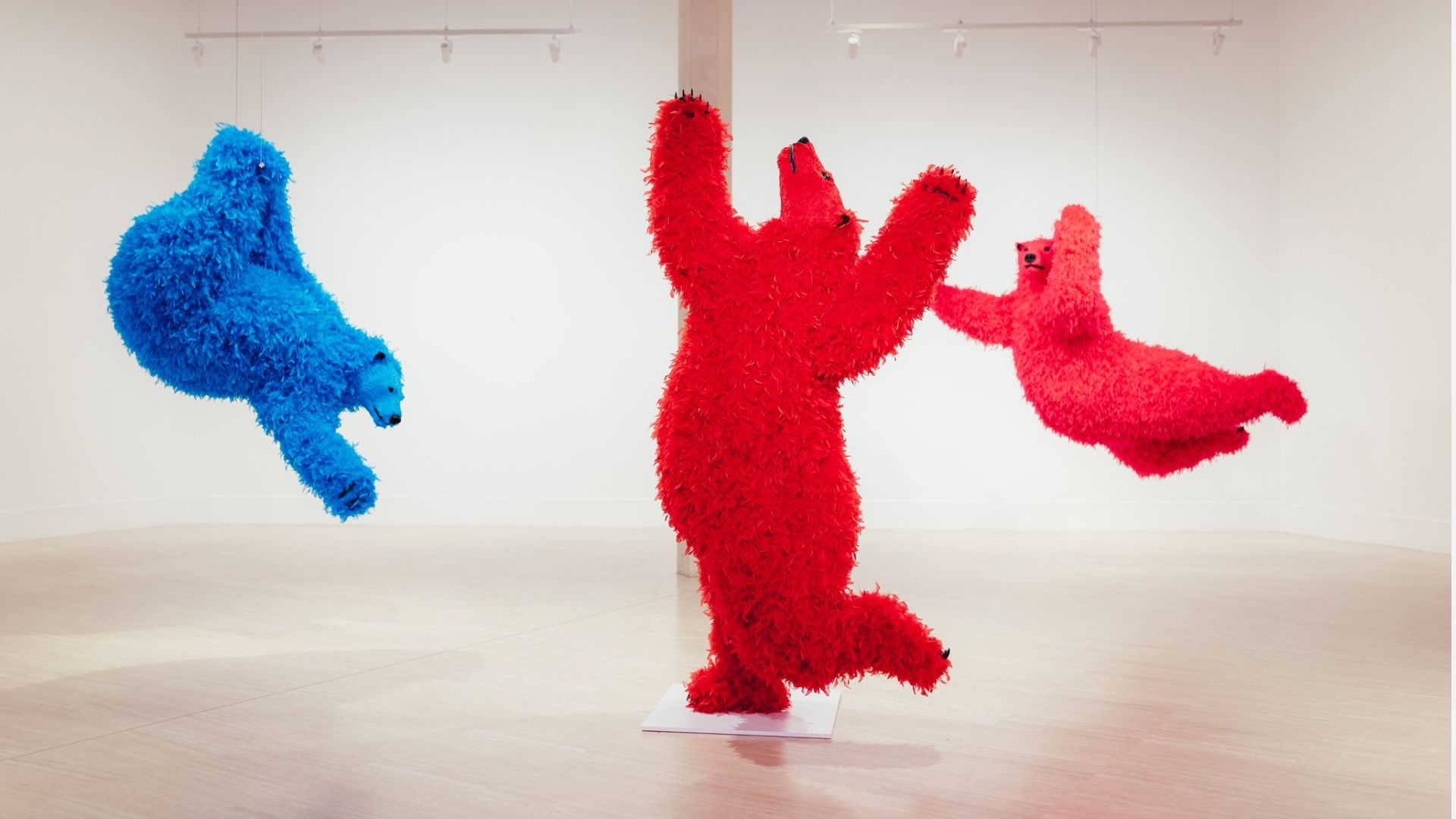
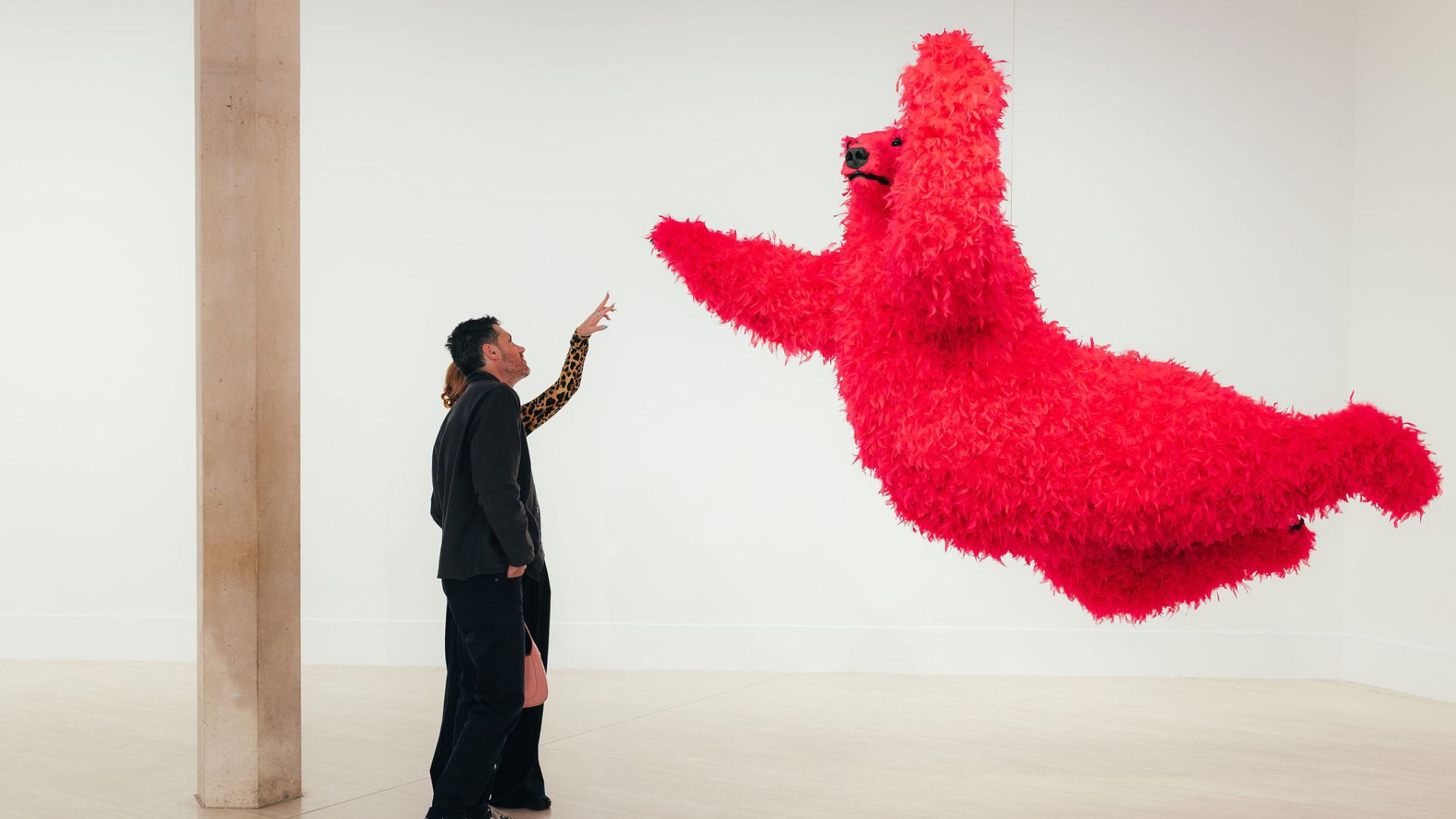
Pivi’s exhibition certainly doesn’t encourage critical scrutiny, with the show’s crowd-pleasing spectacle of dancing bears, floating donkeys, and dazzling trays of glycerine—all radiating crowd-pleasing saturated colours—suggesting that intellectual inquiry is not the point. Pivi’s allergy to argument, if not the discursive, strikes one immediately in the form of a multistorey Lincoln Pierce appropriation work that is unavoidable when entering the gallery. Taking the form of a frame from the comic series Big Nate, we are welcomed to I Don’t Like It, I Love It by the titular comic character reflecting back to us “fortunately, one picture is worth a thousand of those suckers.” Fortunately, indeed.
The Ciesla-Cook collaboration fares better, with its commendable attempt to bring a diverse range of collection works into a dialogue around the fraught nature of contemporary personal relationships. In stark contrast to I Don’t Like It, I love It’s privileging of display over discourse, Attachment Styles is heavily reliant on the didactic reframing of works in order to convert the gallery into what the curators refer to as “a kind of ‘global group therapy session’ as artworks reveal our desires, fears and relational gameplaying.”[1] While references to lovebombing or ghosting can feel strained, if not forced, and imply a degree of familiarity or prosaicness that seems out of place in an art institution, we must again come back to the question of timing and audience—the summer holiday punters having, as far as I could tell, no complaints.
Nevertheless, when examined more closely what could appear like two poor candidates for theoretical examination contrast one another in a genuinely fascinating and thought-provoking way. Broken over two instalments, and taking each exhibition in turn, I will explore the unintended ways in which these two exhibitions speak to the shifting structures of feeling associated with the slow decay of neoliberal hegemony over the last twenty-five years. Ironically, despite her status as a major contemporary artist, Pivi’s work appears nostalgic, even vertiginously so, whereas the Ciesla-Cook collaboration, despite including works as far back as the nineteenth century, more clearly speaks to our current moment of anxiety and social dysfunction.
I Don’t Like It, I Love It presents Pivi as the perfect embodiment (or do I mean caricature?) of the 2000s artist: global brand ambassador, experimental researcher, and life coach. Pivi’s use of animals—goldfish in aeroplane seats, zebras on mountain tops, leopards tiptoeing through cappuccino cups—has been read as part of an art practice that embraces wanderlust, hybridity, and the artist’s ability to champion diversity and commensurability in, by the standards of the early 2000s at least, a newly hyperconnected world. As a review in Frieze put it in 2007, one could “see Pivi’s freewheeling movement as analogous to her ease with using the entire world as a potential subject for her practice.”[2]
Such was a common role for the artist in this period; not so much a proselytiser attempting to globalise a specific worldview or culture, but more a proselytiser for globalised capitalism as an inescapable world culture. Indeed, consistently over her career, Pivi appears as a kind of mascot for the notion of the glocal—the capacity of being a kind of perpetual tourist who nevertheless maintains a powerful sense of place and belonging. As Max Delany writes—and it is worth quoting at length:
Here, Pivi’s work is celebrated both in terms of the artist’s worldly adventurousness and in terms of a concern for the singular ethical and ecological questions raised by the places visited. It is not uncommon to find writing on Pivi that oscillates between the interconnected literary forms of the travel brochure (“Alaska, a place known for its extraordinary geography and geology”) and the airport bookshop non-fiction bestseller (“[…] what it means to be human and how we relate to nature”). The contradictions of global and local, of ecology and consumerism, of spectacle and spiritual, of animal and human, are resolved through the contemporary art practice—or so goes the sales pitch of the 2000s artworld.
![]()
Beyond this declared globetrotting sophistication, Pivi’s works have been generally lauded in terms of their capacity to delight and surprise, although AGWA’s reminder that “no photoshop was used” in the creation of a work like 2003’s Untitled (donkey)—a photograph of a donkey standing in a boat off the island of Alicudi—suggests an anxiety around the diminished power of such works in our current post-internet visual culture. Counterintuitively, perhaps, the failure of these works to excite the imagination as they once did presents us with an opportunity to consider them outside of the strictly aesthetic—that is, to more seriously ask after their social and political meaning. Reading art historian Michele Dantini’s reflections on Pivi’s and transavantgardists like Enzo Cucchi’s respective uses of the donkey in their early 2000s work—which, for the latter, means “the rustic tenacity of the donkey and its congeniality to the perennially-proclaimed sacred and peasant universes of painting”—we can cast Pivi’s use of animals like the donkey in a less optimistic light; not as a joyous and inexplicable burst of creativity, nor as emblematic of the kind of unexpected wonder produced by the miraculous flows of globalisation, but as a symbol of an Italian working class precarious and adrift in the twenty-first century.[4] Indeed, this more pessimistic reading of Pivi’s work as depicting a global workforce that would face renewed exploitation under the regime of globalisation is more convincing when we consider her first exhibition, 1998’s 100 Chinese, a performance work that Stuart Comer described in Artforum as part of the “emerging genre of Exploitation Art” and akin to the works of Santiago Sierra and Artur Zmijewski, in which 100 Chinese people were paid to dress identically and stare at the viewer.[5]
Potentially the most nostalgic work in the exhibition is the most recent: 2025’s Love addict. Comprised of “999 hanging trays containing glycerine coloured with food dye” the work combines formalism and a laboratory aesthetic reminiscent of the 2000s output of artists such as Sarah Morris, Tobias Rehberger, Angela Bulloch, Liam Gillick, and Won Ju Lim. Minimal and yet vaguely futuristic, much work of the 2000s shared an aptness, an “elegant, economical and simple set up” that philosopher Milena Ivanova and her co-authors argue is one of the key aesthetics of scientific experimentation.[6] It is difficult to separate this aesthetic from broader Y2K tech optimism and the emerging knowledge economy. No longer was science, or at least the aesthetics of science, the purview of maladroit nerds or pedantic technicians alone, but was part of a larger cultural moment in which information technology was becoming fun, friendly, and familial. In this way the setup of Love addict shares a resemblance to the era of what has recently been dubbed Frutiger Aero design, with its bubbly harmonisation of the organic and inorganic, human and animal, and work and leisure. Works like Love addict provide an upmarket version of this aesthetic, more minimal than much of Frutiger Aero design other than the incredibly influential iMac G3, and consequently less fun; a kind of Donald Judd for the Pets.com employee.
![]()
At least since the collapse of the dot-com bubble, the knowledge economy and the related figure of the artist as a kind of experimental or mixed-methods researcher began to lose their sheen. It is in this sense that Pivi’s Love Addict feels nostalgically attached to an optimistic and technologically progressivist view of the future—a nostalgia that is shared by many elites within today’s liberal institutions. Indeed, despite Pivi’s complimentary view of the unexpected, counterintuitive, and creative, in past interviews she has been emphatic about art’s and science’s shared roles in combating lies and falsehoods:
Such an idealised view of the science and expertise has aged poorly in the midst of an ongoing reproducibility crisis in psychology and other academic disciplines,[8] not to mention the besieged authority of scientists such as those working in climatology or immunology. Moreover, this maintenance of the 2000’s notion of the artist as a neutral truth-seeking experimental practitioner feels deeply at odds with the current zeitgeist given the way contemporary art has become fundamentally politicised in both right-wing and liberal discourse. Against the subject of Socratic irony, someone who embraces a kind of methodological ignorance in order to begin without presuppositions, the major contemporary artist is—for good or ill—more akin to the figure of the sophist; the skilled rhetorician who, rather than enter into the dialogical and dialectical search for truth, aimed to achieve a practical end guided by some predetermined understanding of things.[9] Against this cultural shift which has seen the artist and artwork as fundamentally politicised, Love addict gestures towards the fragility and instability of the world around us, or as Robert Cook puts it: “with its appearance differing depending on the viewer’s exact position, it very gently speaks to the impossibility of completely experiencing or grasping anything—including any artwork.”[10] This sense of fragility and interconnectivity feels timid and flatfooted, and comes up short when compared with the sense of awe and dread invoked by recent exhibitions of a similar concern, such as the arachnid sculptures of Tomás Saraceno. Despite their ostensibly shared aims, an exhibition like 2018’s Webs of At-tent(s)ion at the Palais de Tokyo pushed the viewer to utterly reorient their senses—both in terms of the exhibition’s enclosed cavernous quality, and in terms of the work’s exploitation of most people’s anxiety at the visible proximity of large spiderwebs. By contrast, Pivi’s reliance on the aesthetics of scientific practice makes too much of too little, as if the mere invocation of scientific aptness should impress upon the viewer that they are in the middle of something dynamic and transformative.
In the wake of the Global Financial Crisis, the financial austerity and scarification of the 2010s, and the populist wave of anger in response to such conditions, it has become increasingly rare to see a straightforward endorsement of globalisation and the knowledge economy. No longer do the technocratic classes celebrate the “great moderation” of the business cycle throughout the 1990s and early 2000s, and lost is the faith in the use of monetary policy alone to create milder recessions and stability in inflation, growth, and unemployment. Looking back, this period created not only a significant number of losers, but a transformation of the economy through which the expansion of the market logic of competition required winners and losers to be discovered in previously egalitarian conditions. For this reason, the figure of the wellness coach and the culture of self-help exploded during the 2000s, such that it is hard not to be taken aback by how uncircumspect Pivi is in her endorsement of an Eat Pray Love worldview. The artist as a multimedia public figure who can inspire and promote change, but with an authentic dose of humility—someone who advocates for the rights of others (Free Humans, 2025) but is self-aware enough to acknowledge their individualistic desires (God, Let Me Hunt, 2008)—has perhaps become banal in the age of the internet microcelebrity and the branded adjacent content creator. It also suggests a comfort and ease with one’s own aspirations and ambivalences that seems out of sync with the age of mass anxiety, ressentiment, and negative solidarity.
It is in relation to these latter issues of pessimistic, wounded, and hostile attachments to the world that I will turn in the second part of this series, where we will contrast I Don’t Like It, I Love It’s embodiment of neoliberal optimism with Attachment Styles’s more pensive approach to our relationship to the world and others. As discussed in the introduction of this first instalment, despite being a largely retrospective exhibition, part two will argue that Ciesla and Cook have been more successful in speaking to a nostalgia for the security and stability of social democracy, and a pervasive sense of contemporary malaise, that encapsulates the structure of feeling of the Trump-COVID era.
Paola Pivi, I don’t like it, I love it, The Art Gallery of Western Australia, 8 November 2025 – 26 April 2026.
Footnotes:
1. https://artgallery.wa.gov.au/wp-content/uploads/2025/12/Attachment-Styles_Large-Print-Labels.pdf
2. https://www.frieze.com/article/tales-unexpected
3. https://www.ngv.vic.gov.au/essay/paola-pivi-you-started-it-i-finish-it/
4. https://www.researchgate.net/profile/Michele-Dantini/publication/268153104_Horses_and_Other_Herbivores_Futurist_Traces_and_Disputed_Identities_in_Contemporary_Italian_Art_1969-2010_in_History_and_Theory_Bezalel_19_January_2011_Future's_PastThe_Italian_Futurism_and_its_Influe/links/546e04a30cf2bc99c2150e1c/Horses-and-Other-Herbivores-Futurist-Traces-and-Disputed-Identities-in-Contemporary-Italian-Art-1969-2010-in-History-and-Theory-Bezalel-19-January-2011-Futures-PastThe-Italian-Futurism-and-its.pdf
5. https://www.artforum.com/columns/stuart-comer-at-the-frieze-art-fair-172598/
6. https://www.sciencedirect.com/science/article/pii/S0039368124000128
7. https://www.interviewmagazine.com/art/paola-pivi-maam
8. For some recent examples see Thibault Le Texier’s Investigating the Stanford Prison Experiment, Ruth Leys’Anatomy of a Train Wreck The Rise and Fall of Priming Research, and Csaba Szabo's Unreliable Bias, Fraud, and the Reproducibility Crisis in Biomedical Research.
9. I write, “for good or ill,” because on the one hand the unambiguous increase in political consciousness amongst artists over the last ten years is probably, on balance, a good thing; especially when contrasted with the above it all ironic pose of much contemporary art in the 2000s. However, on the other hand, such political engagement has often been fairly unsophisticated, reactive, and unsuccessful—and, while jettisoning sophistication and strategy might be acceptable while you’re winning, continual losses somewhat undercut the argument for interminable immediate and urgent action.
10. https://artgallery.wa.gov.au/whats-on/exhibitions/paola-pivi-i-dont-like-it-i-love-it/
Header images: Installation view, ‘Paola Pivi: I don’t like it, I love it’. The Art Gallery of Western Australia (AGWA), Perth, 2025. Art makes you high, 2025. Polyurethane foam, plastic and feathers. 189 x 265 x 145 cm. Courtesy the Artist and Perrotin. © Paola Pivi.
Pivi’s exhibition certainly doesn’t encourage critical scrutiny, with the show’s crowd-pleasing spectacle of dancing bears, floating donkeys, and dazzling trays of glycerine—all radiating crowd-pleasing saturated colours—suggesting that intellectual inquiry is not the point. Pivi’s allergy to argument, if not the discursive, strikes one immediately in the form of a multistorey Lincoln Pierce appropriation work that is unavoidable when entering the gallery. Taking the form of a frame from the comic series Big Nate, we are welcomed to I Don’t Like It, I Love It by the titular comic character reflecting back to us “fortunately, one picture is worth a thousand of those suckers.” Fortunately, indeed.
The Ciesla-Cook collaboration fares better, with its commendable attempt to bring a diverse range of collection works into a dialogue around the fraught nature of contemporary personal relationships. In stark contrast to I Don’t Like It, I love It’s privileging of display over discourse, Attachment Styles is heavily reliant on the didactic reframing of works in order to convert the gallery into what the curators refer to as “a kind of ‘global group therapy session’ as artworks reveal our desires, fears and relational gameplaying.”[1] While references to lovebombing or ghosting can feel strained, if not forced, and imply a degree of familiarity or prosaicness that seems out of place in an art institution, we must again come back to the question of timing and audience—the summer holiday punters having, as far as I could tell, no complaints.
Nevertheless, when examined more closely what could appear like two poor candidates for theoretical examination contrast one another in a genuinely fascinating and thought-provoking way. Broken over two instalments, and taking each exhibition in turn, I will explore the unintended ways in which these two exhibitions speak to the shifting structures of feeling associated with the slow decay of neoliberal hegemony over the last twenty-five years. Ironically, despite her status as a major contemporary artist, Pivi’s work appears nostalgic, even vertiginously so, whereas the Ciesla-Cook collaboration, despite including works as far back as the nineteenth century, more clearly speaks to our current moment of anxiety and social dysfunction.
I Don’t Like It, I Love It presents Pivi as the perfect embodiment (or do I mean caricature?) of the 2000s artist: global brand ambassador, experimental researcher, and life coach. Pivi’s use of animals—goldfish in aeroplane seats, zebras on mountain tops, leopards tiptoeing through cappuccino cups—has been read as part of an art practice that embraces wanderlust, hybridity, and the artist’s ability to champion diversity and commensurability in, by the standards of the early 2000s at least, a newly hyperconnected world. As a review in Frieze put it in 2007, one could “see Pivi’s freewheeling movement as analogous to her ease with using the entire world as a potential subject for her practice.”[2]
Such was a common role for the artist in this period; not so much a proselytiser attempting to globalise a specific worldview or culture, but more a proselytiser for globalised capitalism as an inescapable world culture. Indeed, consistently over her career, Pivi appears as a kind of mascot for the notion of the glocal—the capacity of being a kind of perpetual tourist who nevertheless maintains a powerful sense of place and belonging. As Max Delany writes—and it is worth quoting at length:
born of curiosity about the world and our relationship to it, Pivi’s work is nomadic by nature. The artist has lived in far-flung places: Shanghai, the remote island of Alicudi in southern Italy and, presently, in India. For the past decade she has lived in Anchorage, Alaska, a place known for its extraordinary geography and geology (volcanoes, coast and islands), its ancient and ongoing indigenous histories and cultures, its extreme climatic conditions and great beauty. Alaska is equally known for its wildlife – for marine animals such as walruses and whales, and, of course, for bears – which are increasingly at risk due to melting ice caps, ecological fragility and resource extraction. These ethical and ecological matters are of deep concern to Pivi, whose sculptural practice, through the representation of animals, questions what it means to be human and how we relate to nature.[3]
Here, Pivi’s work is celebrated both in terms of the artist’s worldly adventurousness and in terms of a concern for the singular ethical and ecological questions raised by the places visited. It is not uncommon to find writing on Pivi that oscillates between the interconnected literary forms of the travel brochure (“Alaska, a place known for its extraordinary geography and geology”) and the airport bookshop non-fiction bestseller (“[…] what it means to be human and how we relate to nature”). The contradictions of global and local, of ecology and consumerism, of spectacle and spiritual, of animal and human, are resolved through the contemporary art practice—or so goes the sales pitch of the 2000s artworld.
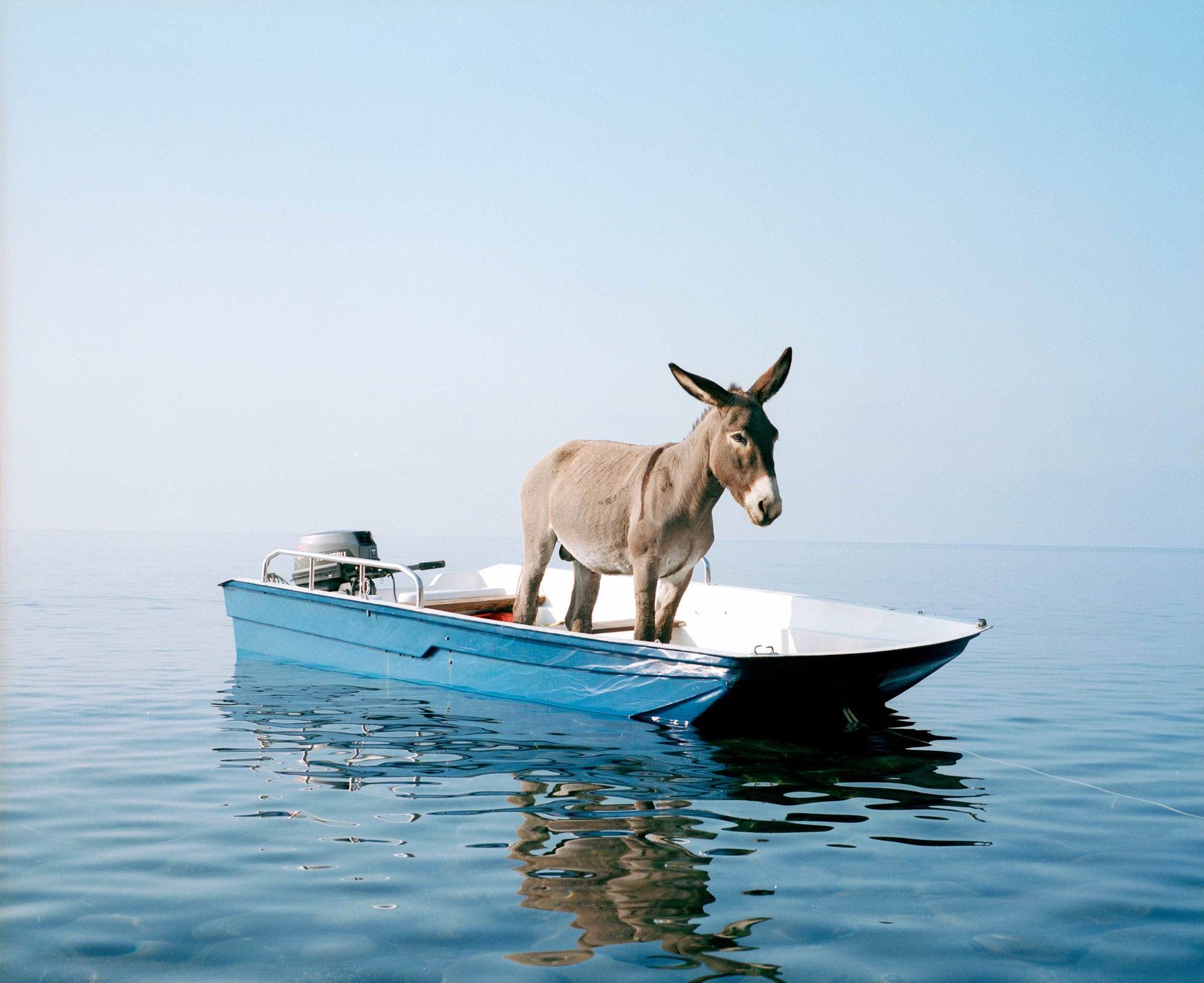
Image:
Paola Pivi, Untitled (donkey), 2003. Framed photographic print, 340 × 423 cm. Courtesy the Artist and Perrotin. © Paola Pivi.
Beyond this declared globetrotting sophistication, Pivi’s works have been generally lauded in terms of their capacity to delight and surprise, although AGWA’s reminder that “no photoshop was used” in the creation of a work like 2003’s Untitled (donkey)—a photograph of a donkey standing in a boat off the island of Alicudi—suggests an anxiety around the diminished power of such works in our current post-internet visual culture. Counterintuitively, perhaps, the failure of these works to excite the imagination as they once did presents us with an opportunity to consider them outside of the strictly aesthetic—that is, to more seriously ask after their social and political meaning. Reading art historian Michele Dantini’s reflections on Pivi’s and transavantgardists like Enzo Cucchi’s respective uses of the donkey in their early 2000s work—which, for the latter, means “the rustic tenacity of the donkey and its congeniality to the perennially-proclaimed sacred and peasant universes of painting”—we can cast Pivi’s use of animals like the donkey in a less optimistic light; not as a joyous and inexplicable burst of creativity, nor as emblematic of the kind of unexpected wonder produced by the miraculous flows of globalisation, but as a symbol of an Italian working class precarious and adrift in the twenty-first century.[4] Indeed, this more pessimistic reading of Pivi’s work as depicting a global workforce that would face renewed exploitation under the regime of globalisation is more convincing when we consider her first exhibition, 1998’s 100 Chinese, a performance work that Stuart Comer described in Artforum as part of the “emerging genre of Exploitation Art” and akin to the works of Santiago Sierra and Artur Zmijewski, in which 100 Chinese people were paid to dress identically and stare at the viewer.[5]
Potentially the most nostalgic work in the exhibition is the most recent: 2025’s Love addict. Comprised of “999 hanging trays containing glycerine coloured with food dye” the work combines formalism and a laboratory aesthetic reminiscent of the 2000s output of artists such as Sarah Morris, Tobias Rehberger, Angela Bulloch, Liam Gillick, and Won Ju Lim. Minimal and yet vaguely futuristic, much work of the 2000s shared an aptness, an “elegant, economical and simple set up” that philosopher Milena Ivanova and her co-authors argue is one of the key aesthetics of scientific experimentation.[6] It is difficult to separate this aesthetic from broader Y2K tech optimism and the emerging knowledge economy. No longer was science, or at least the aesthetics of science, the purview of maladroit nerds or pedantic technicians alone, but was part of a larger cultural moment in which information technology was becoming fun, friendly, and familial. In this way the setup of Love addict shares a resemblance to the era of what has recently been dubbed Frutiger Aero design, with its bubbly harmonisation of the organic and inorganic, human and animal, and work and leisure. Works like Love addict provide an upmarket version of this aesthetic, more minimal than much of Frutiger Aero design other than the incredibly influential iMac G3, and consequently less fun; a kind of Donald Judd for the Pets.com employee.
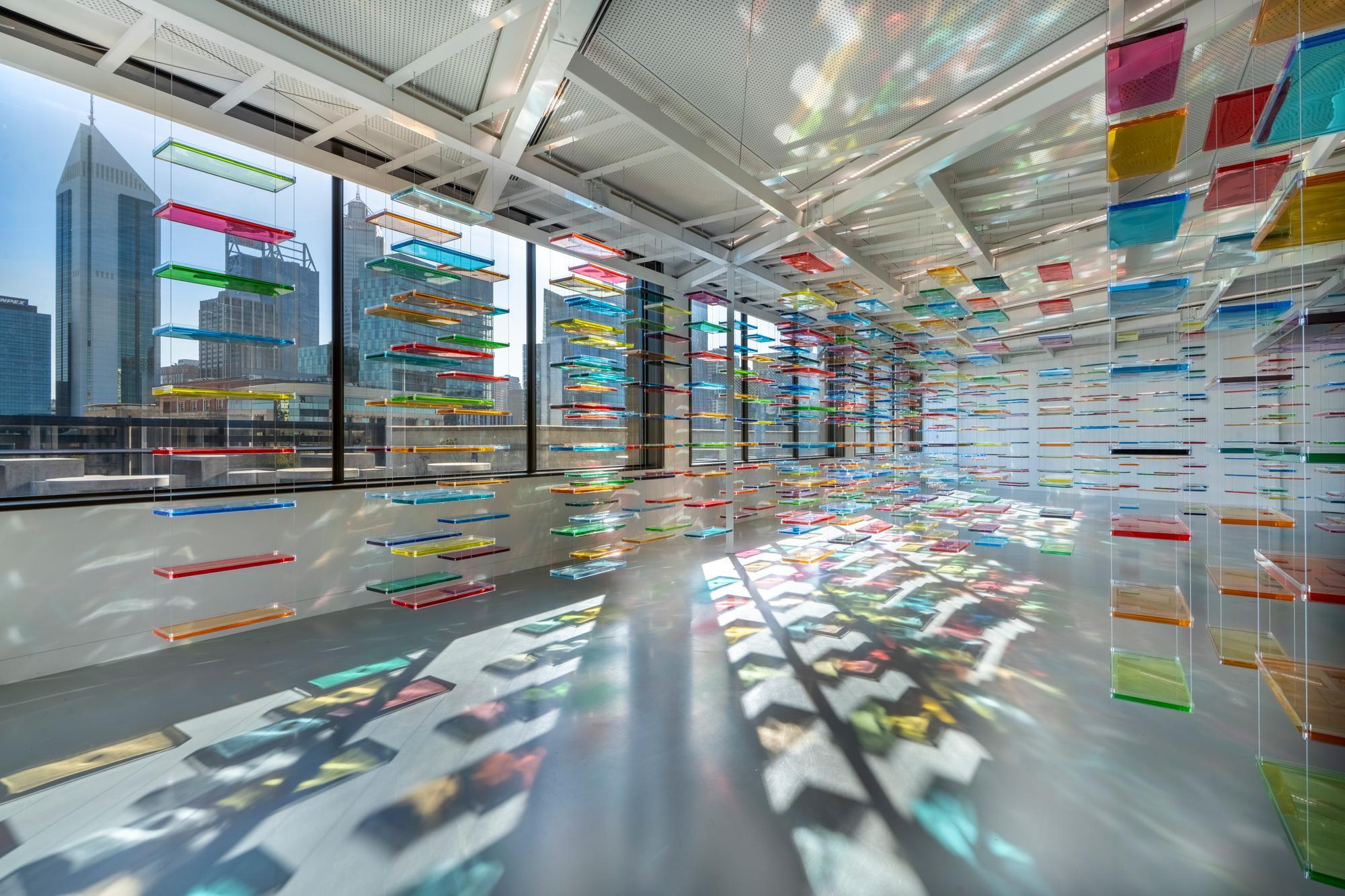
Image: Installation view, The Art Gallery of Western Australia (AGWA), Perth, 2025. Paola Pivi. Love addict, 2025. 999 molded resin trays, glycerine, food colouring. Dimensions variable. Courtesy the Artist and Perrotin. © Paola Pivi. © photo Ela Bialkowska, OKNO studio.
At least since the collapse of the dot-com bubble, the knowledge economy and the related figure of the artist as a kind of experimental or mixed-methods researcher began to lose their sheen. It is in this sense that Pivi’s Love Addict feels nostalgically attached to an optimistic and technologically progressivist view of the future—a nostalgia that is shared by many elites within today’s liberal institutions. Indeed, despite Pivi’s complimentary view of the unexpected, counterintuitive, and creative, in past interviews she has been emphatic about art’s and science’s shared roles in combating lies and falsehoods:
I see lies everywhere—switch on the television, it’s lies. Everything is lies. In the art world or science community, we are intellectuals, people who research, who are interested in learning and thinking. I think the level of lies is way lower than when you step into what I call ‘the outside world.’ There, the level of lies is overwhelming. When you say these things, people will say, ‘No, there are also lies in the art world and scientific world,’ but it’s the extent of its use, or the quantity of people that are not interested in lies and strive for the truth in these research fields that makes a difference.[7]
Such an idealised view of the science and expertise has aged poorly in the midst of an ongoing reproducibility crisis in psychology and other academic disciplines,[8] not to mention the besieged authority of scientists such as those working in climatology or immunology. Moreover, this maintenance of the 2000’s notion of the artist as a neutral truth-seeking experimental practitioner feels deeply at odds with the current zeitgeist given the way contemporary art has become fundamentally politicised in both right-wing and liberal discourse. Against the subject of Socratic irony, someone who embraces a kind of methodological ignorance in order to begin without presuppositions, the major contemporary artist is—for good or ill—more akin to the figure of the sophist; the skilled rhetorician who, rather than enter into the dialogical and dialectical search for truth, aimed to achieve a practical end guided by some predetermined understanding of things.[9] Against this cultural shift which has seen the artist and artwork as fundamentally politicised, Love addict gestures towards the fragility and instability of the world around us, or as Robert Cook puts it: “with its appearance differing depending on the viewer’s exact position, it very gently speaks to the impossibility of completely experiencing or grasping anything—including any artwork.”[10] This sense of fragility and interconnectivity feels timid and flatfooted, and comes up short when compared with the sense of awe and dread invoked by recent exhibitions of a similar concern, such as the arachnid sculptures of Tomás Saraceno. Despite their ostensibly shared aims, an exhibition like 2018’s Webs of At-tent(s)ion at the Palais de Tokyo pushed the viewer to utterly reorient their senses—both in terms of the exhibition’s enclosed cavernous quality, and in terms of the work’s exploitation of most people’s anxiety at the visible proximity of large spiderwebs. By contrast, Pivi’s reliance on the aesthetics of scientific practice makes too much of too little, as if the mere invocation of scientific aptness should impress upon the viewer that they are in the middle of something dynamic and transformative.
In the wake of the Global Financial Crisis, the financial austerity and scarification of the 2010s, and the populist wave of anger in response to such conditions, it has become increasingly rare to see a straightforward endorsement of globalisation and the knowledge economy. No longer do the technocratic classes celebrate the “great moderation” of the business cycle throughout the 1990s and early 2000s, and lost is the faith in the use of monetary policy alone to create milder recessions and stability in inflation, growth, and unemployment. Looking back, this period created not only a significant number of losers, but a transformation of the economy through which the expansion of the market logic of competition required winners and losers to be discovered in previously egalitarian conditions. For this reason, the figure of the wellness coach and the culture of self-help exploded during the 2000s, such that it is hard not to be taken aback by how uncircumspect Pivi is in her endorsement of an Eat Pray Love worldview. The artist as a multimedia public figure who can inspire and promote change, but with an authentic dose of humility—someone who advocates for the rights of others (Free Humans, 2025) but is self-aware enough to acknowledge their individualistic desires (God, Let Me Hunt, 2008)—has perhaps become banal in the age of the internet microcelebrity and the branded adjacent content creator. It also suggests a comfort and ease with one’s own aspirations and ambivalences that seems out of sync with the age of mass anxiety, ressentiment, and negative solidarity.
It is in relation to these latter issues of pessimistic, wounded, and hostile attachments to the world that I will turn in the second part of this series, where we will contrast I Don’t Like It, I Love It’s embodiment of neoliberal optimism with Attachment Styles’s more pensive approach to our relationship to the world and others. As discussed in the introduction of this first instalment, despite being a largely retrospective exhibition, part two will argue that Ciesla and Cook have been more successful in speaking to a nostalgia for the security and stability of social democracy, and a pervasive sense of contemporary malaise, that encapsulates the structure of feeling of the Trump-COVID era.
Paola Pivi, I don’t like it, I love it, The Art Gallery of Western Australia, 8 November 2025 – 26 April 2026.
Footnotes:
1. https://artgallery.wa.gov.au/wp-content/uploads/2025/12/Attachment-Styles_Large-Print-Labels.pdf
2. https://www.frieze.com/article/tales-unexpected
3. https://www.ngv.vic.gov.au/essay/paola-pivi-you-started-it-i-finish-it/
4. https://www.researchgate.net/profile/Michele-Dantini/publication/268153104_Horses_and_Other_Herbivores_Futurist_Traces_and_Disputed_Identities_in_Contemporary_Italian_Art_1969-2010_in_History_and_Theory_Bezalel_19_January_2011_Future's_PastThe_Italian_Futurism_and_its_Influe/links/546e04a30cf2bc99c2150e1c/Horses-and-Other-Herbivores-Futurist-Traces-and-Disputed-Identities-in-Contemporary-Italian-Art-1969-2010-in-History-and-Theory-Bezalel-19-January-2011-Futures-PastThe-Italian-Futurism-and-its.pdf
5. https://www.artforum.com/columns/stuart-comer-at-the-frieze-art-fair-172598/
6. https://www.sciencedirect.com/science/article/pii/S0039368124000128
7. https://www.interviewmagazine.com/art/paola-pivi-maam
8. For some recent examples see Thibault Le Texier’s Investigating the Stanford Prison Experiment, Ruth Leys’Anatomy of a Train Wreck The Rise and Fall of Priming Research, and Csaba Szabo's Unreliable Bias, Fraud, and the Reproducibility Crisis in Biomedical Research.
9. I write, “for good or ill,” because on the one hand the unambiguous increase in political consciousness amongst artists over the last ten years is probably, on balance, a good thing; especially when contrasted with the above it all ironic pose of much contemporary art in the 2000s. However, on the other hand, such political engagement has often been fairly unsophisticated, reactive, and unsuccessful—and, while jettisoning sophistication and strategy might be acceptable while you’re winning, continual losses somewhat undercut the argument for interminable immediate and urgent action.
10. https://artgallery.wa.gov.au/whats-on/exhibitions/paola-pivi-i-dont-like-it-i-love-it/
Header images: Installation view, ‘Paola Pivi: I don’t like it, I love it’. The Art Gallery of Western Australia (AGWA), Perth, 2025. Art makes you high, 2025. Polyurethane foam, plastic and feathers. 189 x 265 x 145 cm. Courtesy the Artist and Perrotin. © Paola Pivi.