Dispatch Review respectfully acknowledges the Whadjuk people as the traditional owners and custodians of the lands upon which we live and work. We pay deep respect to Elders past and present. Always was, always will be Aboriginal land.
Reviews:
- All alone in the dark: After Elvira Madigan (1967), Salon dans l’obscurité, by Amy Hickman.
- Hatched Dispatched 2026 by Lilian Brown, Lucy Kilroe, Riley Landau, Cassandra Otterman-Emmett, and Charlotte Newman.
- Felix McNamara’s Atrocities by Patrick Zaia.
- Once More with Feeling by Grace Coppola.
- Deanna Hitti's Dangerous Pleasures by Anna Daly.
- Sherrie Levine: Press Release by Sam Beard.
- BCC at Blindside by Diego Ramírez.
- Jack Ball, Mystery Solved by Siân McIntyre.
- 2026 Power 100 by Dispatch Review.
- Patches in a Glowing Landscape: A Reading Gregory Pryor’s Huddle Exhibition by Jonathan W. Marshall.
- Pure Intention: Singapore Biennale 2025–26 by Marco Marcon.
- Gemma Weston, WITNESSING by Sam Beard and Francis Russell.
- Painting Itself: Artist Interviews by Felicity Ostergaard and William Bromage.
- Flooding The Zone by Paul Sutherland.
- Something Old, Something New by Duncan McKay.
- Theo Koning by Marco Marcon.
- Jacob Kotzee: Stimela by Grace Coppola.
- Feel Bad Hit of the Summer Pt. 2 by Francis Russell.
- Isn’t there someone you forgot to ask? by Amy Hickman.
- Isabel Bereczky: Outsole by Chelsea Hopper.
- On Dreaming by Stirling Kain.
- Feel Bad Hit of the Summer Pt. 1 by Francis Russell.
- Lucas “Granpa” Abela at _____g.s by Nalinie See.
- Alana Hunt, A Deceptively Simple Need, PICA by Marco Marcon.
- Wang Qingsong’s Everlasting Inscription by Sam Beard.
- Dispatch Review's 2025 Wrap-up.
- Ripairian: Imprinting the Living Landscape by Annette Peterson.
- Corpse-Watching Comes to Perth by Riley Landau.
- Queering Kin: Amos Gebhardt’s Family Portrait by Riley Landau.
- Forget AI by Francis Russell.
- Acid Utopia: Judgment Day by Aimee Dodds.
- Mollescent Irritant: Liam Gillick at Disneyland Paris by Aimee Dodds.
- Kieron Broadhurst and Ash Tower: Border Chronicle by Soph Grey.
- Nan Goldin, Voyeurism, and the NGA by Jess van Heerden.
- Bombard the Headquarters: An Interview with Linda Jaivin by Sam Beard.
- Hatched Dispatched 2025, by Maraya Takoniatis, Riley Landau, Nalinie See, Kye Fisher, and Jess van Heerden.
- Sneak Out by Tara Heffernan.
- By Chance, Li Gang by Sam Beard.
- Nazila Jahangir, Immigration by Sam Beard.
- Regenerative Strategies: A Celestial Reflection by Jess van Heerden.
- Cast in (Mostly) Bronze at AGWA by Riley Landau.
- Missed Shows and Mini Reviews by Darren Jorgensen, Riley Landau, Amelia Birch, and Sam Beard.
- 2025 Power 100, by Dispatch Review.
- Dan Bourke, Keywords, AVA by Francis Russell.
- Revivification at AGWA by Angus Bowskill.
- The Australian Dream and other Fictions by Jess van Heerden.
- The Vessel Report by Sam Beard.
- Jacob Kotzee’s flowerfield by Scott Price.
- Jeff Gibson: False Gestalt by Francis Russell.
- Skyward, or Boonji Spaceman and the Giant Kebab by Nick FitzPatrick.
- Sam Bloor and Jesse Marlow: Street Posters 2020–2025 by Sam Beard.
- Mervyn Street: Stolen Wages by Darren Jorgensen.
- 100 Sculpture Ideas for Sculptures by the Sea by Rainy Colbert.
- Kate Mitchell’s Idea Induction by Amelia Birch.
- Mai Nguyễn-Long’s Doba Nation by Sam Beard.
- A conversation with Jo Darbyshire, by Stirling Kain.
- Dispatch Review’s 2024 Wrap-up.
- The people yearn... by Max Vickery and Erin Russell.
- An invitation to dance by Sam Beard.
- We Talk, We Discuss: An Interview with Taring Padi by Max Vickery.
- AGWA x PrideFEST by Felicity Bean.
- Tim Meakins, Body Mould by Sam Beard.
- Nick FitzPatrick, Hero Image by Francis Russell.
- Jacob Kotzee, Arrangements by Dan Glover.
- Hollow Icons: Desmond Mah at Mossenson by Darren Jorgensen.
- Pilgrimage: An interview with Vedika Rampal.
- The UnAustralian: Doubling Double Nation – An interview with Rex Butler.
- Negative Criticism: A Year of Dispatch Review by Tara Heffernan.
- Custodians as Reverse Monument by Darren Jorgensen.
- End of History – LWAG by Francis Russell.
- Hatched Dispatched 2024 by Dan Glover, Jess van Heerden, Nalinie See & Sam Beard.
- David Bromfield: A critic at large and ‘Where did the artists go?’
- Me, Also Me by Sam Beard.
- Paper Trails Between Lion and Swan by Sam Beard.
- Ceramically Speaking by Ben Yaxley.
- The Strelley Mob by Sam Harper.
- Rone: The Mighty Success by Leslie Thompson.
- Paper Trails: An interview with Yeo Chee Kiong by Sam Beard.
- 2024 Power 100 by Dispatch Review.
- Foresight & Fiction by Ben Yaxley.
- Twin Peaks Was 30 by Matthew Taggart.
- Breaking News: It’s Rone! by Sam Beard.
- Look, looking at Anna Park by Amelia Birch.
- The Fan by Francis Russell.
- Follower, Leader by Maraya Takoniatis.
- Wanneroo Warholamania by Sam Beard.
- Death Metal Summer by Sam Beard.
- Players, Places: Reprised, Renewed, Reviewed by Aimee Dodds.
- Scholtz: Two Worlds Apart by Corderoy, Fisher, Flaherty, Wilson, Fletcher, Jorgensen, & Glover.
- Partial Sightings by Sam Beard.
- True! Crime. by Aimee Dodds.
- The Human Condition by Rex Butler.
- Rebecca Baumann’s Light Event by Sam Beard.
- Rejoinder: Archival / Activism by Max Vickery.
- Access and Denial in The Purple Shall Govern by Jess van Heerden.
- 4Spells by Sam Beard.
- Abstract art, DMT capitalism and the ugliness of David Attwood’s paintings
by Darren Jorgensen. - Unearthing new epistemologies of extraction by Samuel Beilby.
- Seek Wisdom by Max Vickery.
- Something for Everyone by Sam Beard.
- Violent Sludge by Aimee Dodds.
- State of Abstraction by Francis Russell.
- Double Histories: Special Issue, with texts by Ian McLean, Terry Smith, and Darren Jorgensen & Sam Beard.
- Six Missing Shows by Sam Beard.
- What We Memorialise by Max Vickery.
- At the End of the Land by Amelia Birch.
- The beautiful is useful by Sam Beard.
- ām / ammā / mā maram by Zali Morgan.
- Making Ground, Breaking Ground by Maraya Takoniatis.
- Art as Asset by Sam Beard.
- Cactus Malpractice by Aimee Dodds.
- Sweet sweet pea by Sam Beard.
- COBRA by Francis Russell.
- PICA Barn by Sam Beard.
- Gallery Hotel Metro by Aimee Dodds.
- A Stroll Through the Sacred, Profane, and Bizarre by Samuel Beilby.
- Filling in the Gaps at Spacingout by Maraya Takoniatis.
- Disneyland Cosmoplitanism by Sam Beard.
- Discovering Revenue by Amelia Birch.
- Uncomfortable Borrowing by Jess van Heerden.
- It’s Not That Strange by Stirling Kain.
- Hatched Dispatched 2023 by Sam Beard & Aimee Dodds.
- Fuck the Class System by Jess van Heerden, Jacinta Posik, Darren Jorgensen, et al.
- Wild About Nothing by Sam Beard.
- Paranoiac, Peripatetic: Pet Projects by Aimee Dodds.
- An Odd Moment for Women’s Art by Maraya Takoniatis.
- Transmutations by Sam Beard.
- The Post-Vandal by Sam Beard.
- Art Thugs and Humbugs by Max Vickery.
- Disneyland, Paris, Ardross and the artworld by Darren Jorgensen.
- Bizarrely, A Biennale by Aimee Dodds.
- Venus in Tullamarine by Sam Beard.
- Weird Rituals by Sam Beard.
- Random Cube by Francis Russell.
- Yeah, Nah, Rockpool by Aimee Dodds.
- Towards a Blind Horizon by Kieron Broadhurst.
- Being Realistic by Sam Beard.
I’ve always felt that virtue lay in obtaining what was out of one’s reach, in living where one isn’t, […] in overcoming – like an obstacle – the world’s very reality.
— Bernardo Soares (Fernando Pessoa),
The Book of Disquiet (1982)
The dreams of Yasamin Khadembashi are not idle interludes between waking hours. Her dreams are (in equal parts) strained and cathartic extensions outwards. Indeed, she dedicates this exhibition to her parents’ flight from Iran, pursuing “…the possibility that their children could grow in a country where they would be free.”[1] It could be argued that Khadembashi materialises her own dreams by supplementing cultural erasure with artistic excess: this is where we arrive at Dreaming in Farsi.Her first solo exhibition, Dreaming in Farsi is the culmination of Khadembashi’s residency at Pakenham Street Arts Space. This gallery—large, open, concrete-grey—can be challenging, especially for emerging artists. Khadembashi has achieved an exhibition that feels balanced and full with only eighteen two-dimensional works.
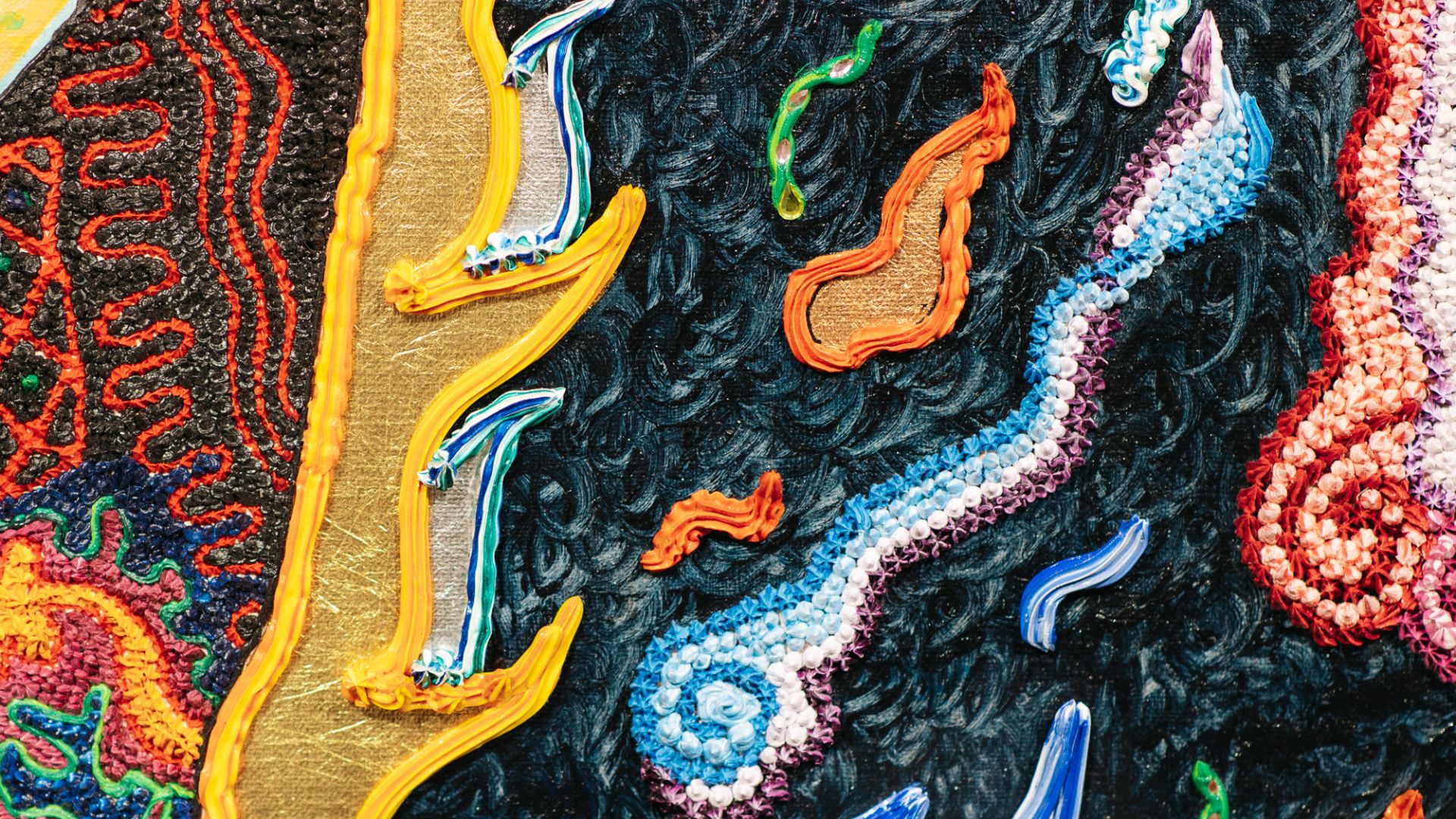
Sometimes artists use experimental methods to disguise a lack of technical aptitude—the kind involved in the presentation of fully resolved work. This is not the case with Khadembashi. She is immediately recognisable as an accomplished figurative oil painter, exploring with sculptural impasto and novel materials (including synthetic eyelash extensions and rhinestones).
At the end of my first walkthrough of the exhibition, I notice none of the works are framed. They don’t need them. The variance in the scale of works (from 15.5cm up to 197cm) indicates that she is a confident painter seeking to create a diverse body of work. Khadembashi relishes the medium, embracing both its opportunities and its challenges, but does not overly rely on scale, frames, or experimentation to elevate her works.
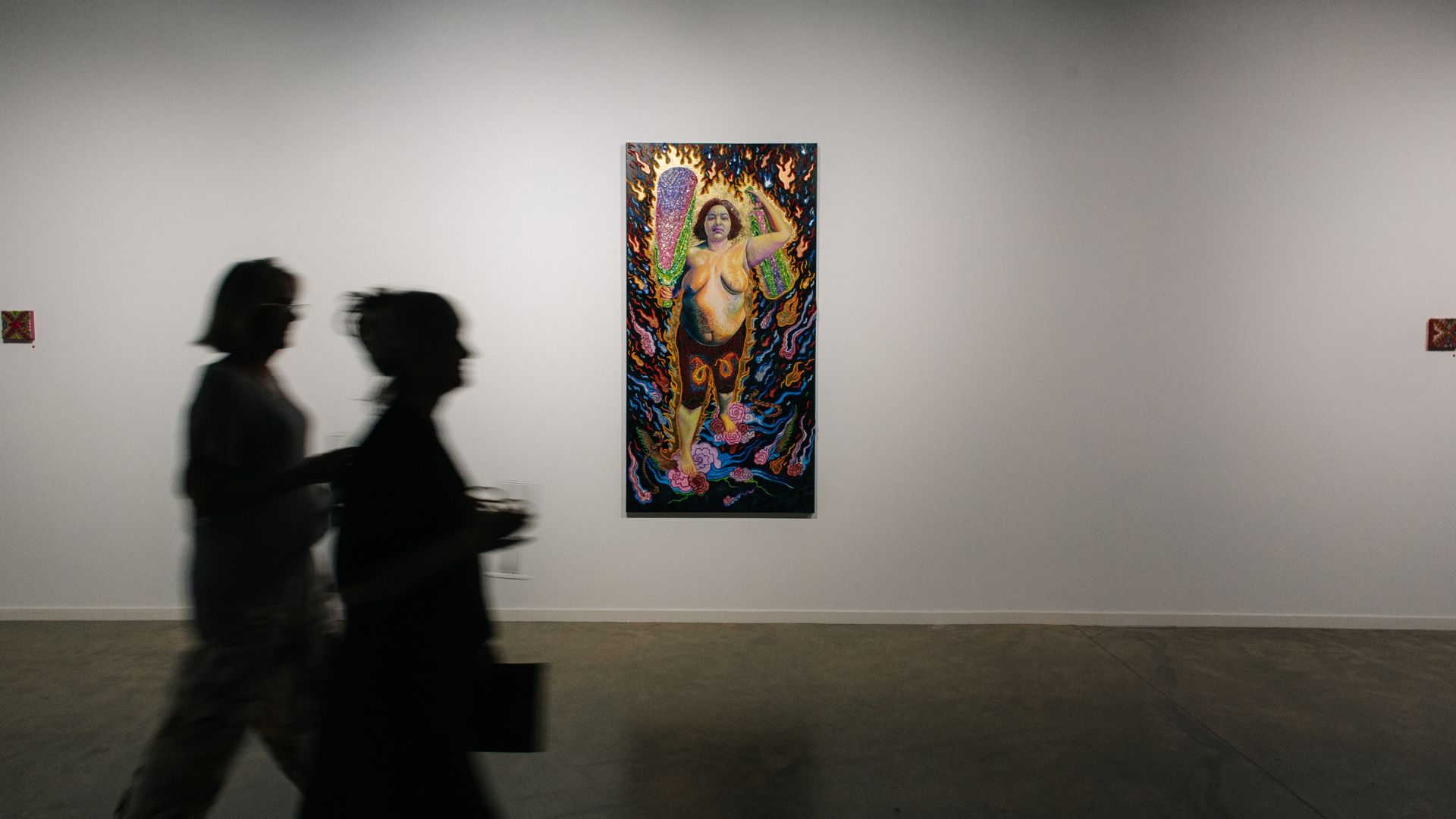
At the exhibition’s opening, audiences consistently gravitate towards the larger-than-life-sized Immoral Warrior. Khadembashi is topless, floating in air, stepping towards the viewer, and wielding flaming, rhinestone-emblazoned paddles. Bold and surreal, the work is reminiscent of Julie Rrap’s 1984 cibachrome print series Persona & Shadow.[2] Immoral Warrior re-imagines some of the values invigorating Rrap’s work with new intersectionality: Khadembashi is fat and Australian-Iranian, where Rrap is thin and white. In the artist’s own words: “These paintings embody the queer, the camp, the fat, the feminine, the masculine, the grotesque, the beautiful, the powerful, the big, the vulnerable, the bold.”[3]
In a phone call, Khadembashi conveys (with urgency) the frustration she feels at the opinions of some left-leaning commentators as they look upon protests in Iran. She emphasises nuance. She describes an example where Iranian protesters set fire to a mosque. These are not thoughtless expressions of violence, but protests to demand freedoms from their government. The prioritisation of nuance is clear in her works, too. Dreaming in Farsi balances earnestness and defiance, demanding reflection and attention. Ultimately, the works foreground representation exclusively on Khadembashi’s own terms. In Don’t Act Suspicious, florid designs border a woman wearing a burqa, with a red-and-white target on her torso. Her gaze and body face the viewer, who must shuffle around to read the tiny words across her clothing, scored into the surface of the paint. The work requires the audience to meet the subject. She stands as a target of Islamophobia, but is neither dangerous, nor pitiable—rather, steadfast and individual. Indeed, Khadembashi says that “these works ask to be witnessed rather than consumed.”[4]
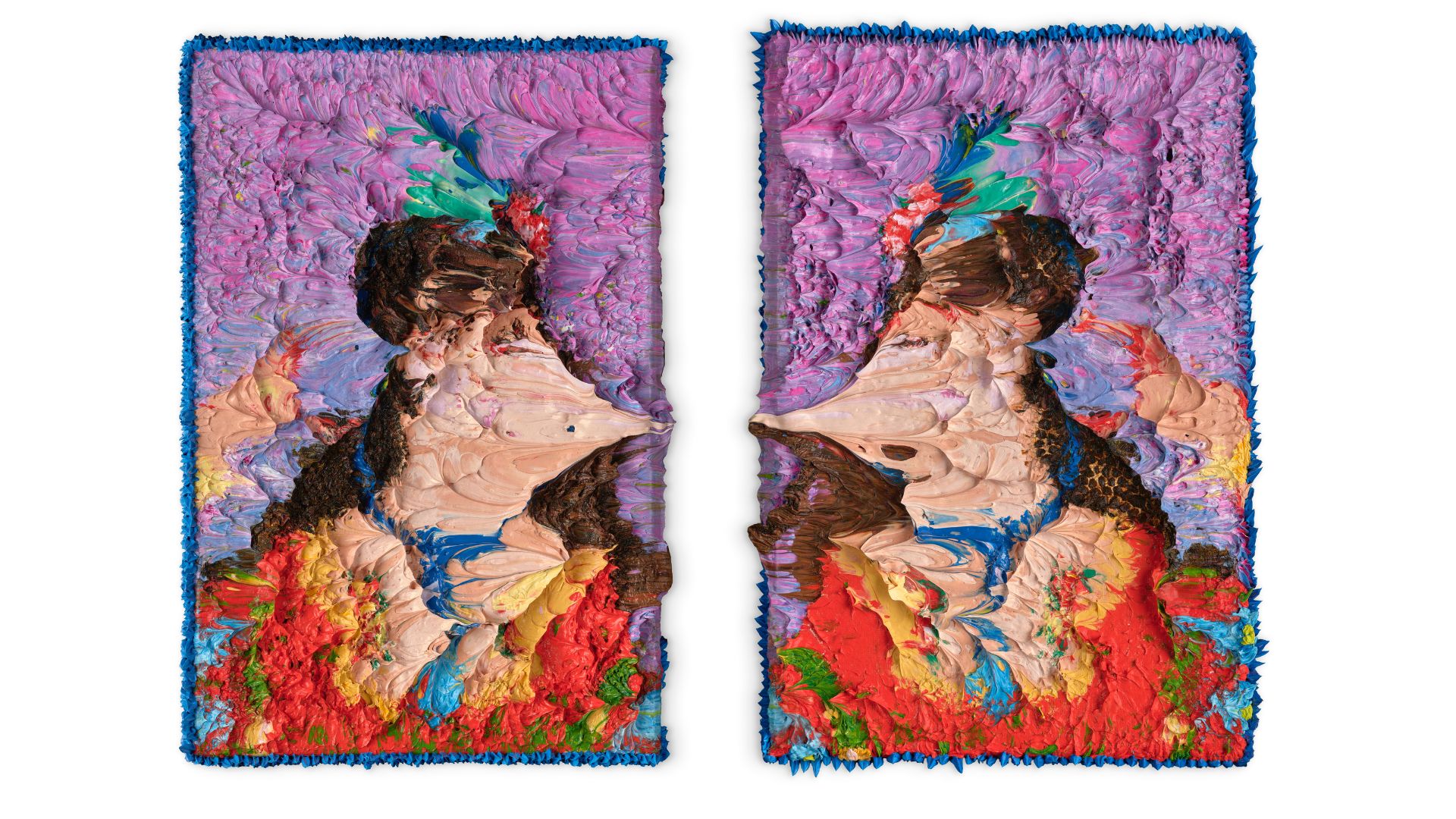
Rorschach Miniature (31.5cm x 42.5cm, two canvases) is perhaps my favourite work. The surfaces of this diptych are thick with lashings of purple, red, peach, and blue oil paint. The two portraits are mirrors of one another, the featureless faces extending and pointing towards each other. The impasto is so abundant that it almost bridges the gap between the two canvases. The work conveys longing, discomfort, and a density of feeling.
Khadembashi says she was influenced by Ben Quilty’s Rorschach paintings. She paints on canvas, then presses upon that surface a plain canvas of the same size, and usually repeats this pressing and pulling. Khadembashi describes this as a visual metaphor of immigration and assimilation—an image that was once present is irrevocably changed through repeated pressing and pulling. The artist’s experiments with oil paints are a material expression of the role of erasure and loss in the complex and sometimes contradictory unfolding of her Australian-Iranian identity.
When first entering the exhibition, audiences encounter a group of earlier works, created in 2022 and 2023. On the next wall, Immoral Warrior (2025) sits between Dyke (2025) and Patterned No. 1 (2024), all of which primarily include piped impasto oil paint. Towards the end of the show, the works Insomnia, Three Sisters, and Faceless (all 2022) depict ghostly, photo-negative portraits markedly different from the rest of the works. These curatorial choices diverge from my own tastes: perhaps the different chronological and thematic clusters that comprise the show could have been better integrated and reconciled by interspersing them less linearly. This might have facilitated a sense of the works looping back on themselves—forming additional visual connections between paintings that are not physically next to each other—rather than the linear-leaning storytelling mode Khadembashi has adopted.
That being said, the artist should be commended for the breathing room she provides each work. A common pitfall for emerging artists curating their own exhibitions is to jam in as many works as possible, because they are deeply connected to each piece and cannot bear any omission. Khadembahsi uses the space between paintings as a collaborator: a critical component to distinguishing each work.
Dreaming in Farsi combines painterly experimentation with technical excellence, bringing vernacular materials and Australian-Iranian subjectivity to the long tradition of oils. The love and labour Khadembashi pours into each work is tangible. This selection of paintings have a rare quality, providing instantaneous aesthetic pleasure—with their luscious impasto on canvas surfaces—while rewarding longer study.
Yasamin Khadembashi, Dreaming in Farsi, Pakenham Street Arts Space, 17–31 January.
Footnotes:
1. Dreaming in Farsi | Yasamin Khadembashi (exhibition catalogue), 2026.
2. Julie Rrap, Persona & Shadow, cibachrome prints, 1984. https://www.julierrap.com/work/persona-and-shadow
3. Dreaming in Farsi | Yasamin Khadembashi (exhibition catalogue), 2026.
4. Dreaming in Farsi | Yasamin Khadembashi (exhibition catalogue), 2026.
Image credits:
1. Yasamin Khadembashi, Rorschach Miniature, 31.5cm x 42.5cm, two canvases. Courtesy of the artist.
2. Yasamin Khadembashi , Immoral-Warrior (install documentation). Courtesy of the artist.
3. Yasamin Khadembashi , Immoral Warrior (detail). Courtesy of the artist.
Photos by Adam Kenna.